Showing posts with label Puffin Books. Show all posts

Friday, 20 June 2025

40 Years of The Crown of Kings

2025 marks 40 years since the publication of The Crown of Kings, the final volume of Steve Jackson's seminal gamebook miniseries, Sorcery!

The conclusion of the Sorcery! series starts with the Analander climbing through the Xamen Peaks to reach the Mampang Fortress, and then battle their way through the Archmage’s lair. The Crown of Kings came in at a whopping 800 references (a record yet to be broken by any other Fighting Fantasy gamebook) and was as epic an adventure as any Sorcery! fan could have hoped for. It also featured one of the most memorable (and clever) denouements of any adventure ever published, not to mention encounters with a god-headed Hydra and entire societies of birdmen and she-satyrs.

The God-headed Hydra, by John Blanche.

When pressed on the subject of which of the gamebooks he has written are his favourites, Jackson cites two: “Warlock because it was the first. And Sorcery! because it was the most complex. Creating a four-part adventure in which your actions in Book 2 might affect your choices in Book 4 was a real challenge.”

All four volumes are in print again in the UK, courtesy of Scholastic Books. And all four volumes are also now available in Portuguese, from Brazilian publisher JambĂ´ Editora, including The Crown of Kings, which had previously been available in Brazil.

Rather like the recent Danish editions of the Sorcery! series, the Brazilian ones also come with a unique slipcase.

The Brazilian Sorcery! quartet.

The Danish Sorcery! quartet, plus Spell Book.
 

Thursday, 23 January 2025

Marc Gascoigne Announced as new Fighting Fantasy Brand Manager

LONDON, UK  |  23 JANUARY 2025

Steve Jackson and Sir Ian Livingstone, the co-creators of Fighting Fantasy, have recruited Marc Gascoigne as Brand Manager of the bestselling gamebook series. The classic series of adventure gamebooks, which began in 1982 with The Warlockof Firetop Mountain, continues to thrive with new titles being published by Scholastic UK, together with digital and audio editions, role-playing and board games, miniatures, and a growing range of licensed merchandise.

With more than 20 million books sold in over 30 languages, Fighting Fantasy remains a truly global phenomenon. The series will be returning to US bookstores in mid-2025 with 10 titles being published by Steve Jackson Games Inc (run by the other Steve Jackson in the USA).

Marc will be supporting existing Fighting Fantasy licensees, as well as seeking out appropriate partners for new ventures. Long-time Fighting Fantasy fans will already be familiar with Marc’s work from the legendary sourcebooks Titan—the Fighting Fantasy World and the Fighting Fantasy monster collection Out of the Pit, the gamebook Battleblade Warrior, and two Fighting Fantasy novels. He was also the series’ consultant editor in the 1990s for Puffin Books, before building a career in fantasy fiction as publisher of Games Workshop’s Black Library range of Warhammer novels, and later with his own award winning imprint Angry Robot.

Sir Ian Livingstone said: “We are delighted to have Marc join us to further promote and build Fighting Fantasy worldwide. A respected expert of the genre, he will be an invaluable member of the Fighting Fantasy team. May his STAMINA never fail!” 

Sir Ian Livingstone and Marc Gascoigne at Dragonmeet 2024.

You can read the full press release here.


Sunday, 31 October 2021

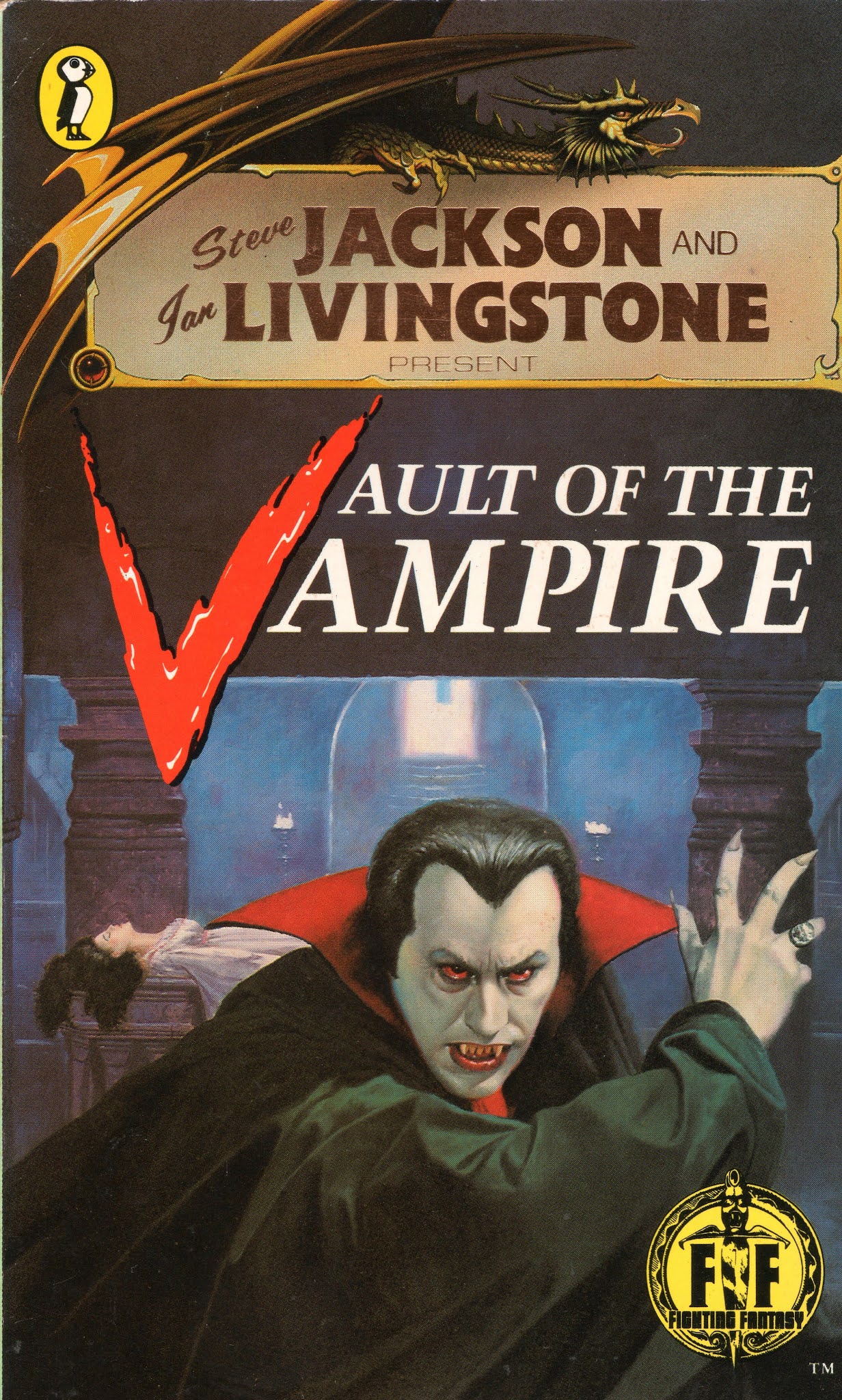
Blast from the Past! Vault of the Vampire

Published in 1989, Vault of the Vampire was the 38th gamebook in the Fighting Fantasy series. Written by the late Carl Sargent, under the name Keith Martin, and illustrated by the late Martin McKenna, FF's riff on Dracula is a bona fide classic of interactive horror fiction.

Interestingly, despite blood-suckers appearing on a regular basis throughout the previous thirty-seven titles, up until this point no one prince of the night had taken centre stage and become the Big Bad to be dealt with at the climax of an adventure.

Keith Martin rectified this by transporting the reader to Titan's version of Transylvania, set within the mountainous Old World realm of Mauristatia, replete with wolves howling at the moon, creepy forests, a headless coachman, and a sinister, bat-haunted castle.

The plot is also just what you would want from a story called Vault of the Vampire...


Can you put an end to Count Heydrich's evil reign of terror?

YOU are a hardy adventurer and have journeyed to the icy mountains of Mauristatia in search of great wealth and fortune... but what you find there makes your blood run cold.

You discover by chance the terrible secret of the local villagers. Can YOU free them from the evil tyranny of the bloodthirsty Count, or will you too succumb to a horrifying fate?

Two dice, a pencil and an eraser are all you need. YOU decide which paths to take, which dangers to risk and which foes to fight!


Les Edwards painted the cover for the book: “Vault of the Vampire turned out to be one of those classic images. I can’t say why exactly. It’s just one of those cases where everything works the way that was intended. It’s a pretty traditional Vampire but maybe that’s part of its strength. It’s a simple and dramatic image and very direct. It was a big influence on Vampire paintings that I did subsequently.”

Martin McKenna, who was still only eighteen at the time, turned his hand to producing some very Hammer Horror-esque images for the book’s internal illustrations that have stood up to the test of time very well.


A blood-soaked sequel followed in 1995, entitled Revenge of the Vampire. This was the only occasion a direct sequel to a gamebook was written by an author other than the series’ co-creators Jackson and Livingstone.

Revenge of the Vampire (FF58) was Keith Martin’s seventh contribution to the Fighting Fantasy gamebook series. In the story, Count Reiner Heydrich returns from the dead once more to stalk the Old World in search of fresh blood and new slaves. It is up to the hero (who is not the same hero as featured in Vault of the Vampire) to put an end to him once and for all.


Count Heydrich, Vampire, is back from the dead!

A half-forgotten evil has arisen from the grave to stalk the Old World in search of fresh blood and new victims to enslave. Count Reiner Heydrich, undead Vampire Lord, is ancient beyond the reckoning of mortals. This time, however, there is someone on his trail, a brave hero who is determined that he shall not succeed in his evil plans. That someone is YOU!


As well as being written by Keith Martin, author of Vault of the Vampire, once again Les Edwards painted the stunning cover image while Martin McKenna came up trumps with the internals.


Friday, 25 June 2021

Blast from the Past! Spellbreaker

Spellbreaker
(FF53) was published 28 years ago this week, while its author, Jonathan Green, was still studying at university.

The story begins with the hero inadvertently enabling Nazek (another Warlock) to steal the Black Grimoire from its guardians at Rassin Abbey in the Old World kingdom of Ruddlestone. To make amends, the hero sets out to track down the villain in order to stop him from opening the legendary Casket of Shadows, and releasing the evil imprisoned within.

Art – both exterior and interior – was provided by Alan Langford. It was the first and last time the artist painted a cover for the series, despite having illustrated five FF adventures before Spellbreaker.

“They just asked me to do it,” says Langford, “which was rather nice, because you get paid rather more for cover art than you do for your inside work.” The image was produced using predominantly watercolours. “I used a little bit of permanent white gouache as well, which is my normal technique for watercolour.”

The Devilworm, which was inspired by the legend of the Lambton Worm.

One of the internal pen and ink illustrations provided by Alan Langford.

(© Alan Langford, 1993)

However, when Wizard Books republished the adventure in 2007, Martin McKenna was commissioned to produce a new piece of cover art, which was done digitally. (Green had been keen to have McKenna illustrate one of his FF adventures ever since being commissioned to write Spellbreaker, back in 1992.)


Despite being incredibly difficult to complete fairly, Spellbreaker still has its fans among the Fighting Fantasy community.

Did you know...?

It was John Sibbick’s image of a dragon attacking a band of adventurers, determined to steal its treasure hoard, that appeared on the front cover of Dungeoneerthat inspired Green to write Spellbreaker in the first place, because he thought the forward-facing dragon was actually a demon!


Friday, 8 January 2021

Blast from the Past! Clash of the Princes

In 1986 the first two-player Fighting Fantasy gamebook experience, Clash of the Princes, was published.

“I remember one of the Penguin editors saying they’d had a submission from Australia which was a two-player FF game,” Jackson recalls. “We agreed it should be in the FF series.”

Clash of the Princes was written by Andrew Chapman (author of Space Assassin, The Rings of Kether and Seas of Blood) and Martin Allen (who would go on to write Sky Lord).

As to what Clash of the Princes was all about, the blurb on the back of the book said it all:

At last — a thrilling TWO-PLAYER, two-book Fighting Fantasy adventure!

The perilous Trial of Kingship awaits you! In the golden city of Gundobad, you are twin princes – one a Warrior-Prince and one a Warlock-Prince – each with your own particular skills and strengths. It is time for one of you to succeed to the throne, and you must face the Trial of Kingship. But only one of you can win through. Which brother will it be?

Beware! Vile monsters and deadly dangers lie in wait. Two dice, a pencil, an eraser – and a friend! – are all you need.

The two books that made up Clash of the PrincesThe Warrior’s Way and The Warlock’s Way – were released as a boxed set. They could be still be played as standard solo Fighting Fantasy gamebooks but of course they could also be combined to create a unique two-player role-playing experience. Two new attributes were used in the two-player version, ACTION and STATUS. These allowed the two players to synchronize their individual gaming experiences.

The Warrior’s Way cast the hero as Clovis, Warrior-Prince of the golden city of Gundobad. The Warlock’s Way made the hero Lothar, the Warlock-Prince, Clovis’s twin brother and rival. In the books, both set out upon the somewhat draconian Trial of Kingship to see which of them will succeed to the throne of Gundobad.

The two books were both illustrated by John Blanche, inside and out. “I think Clash of the Princes came about because Geoff Taylor recommended me to the publishers,” reckons Blanche.

Minotaur and Warthog Guard, by John Blanche.

Both books have a total of 500 references each, making a grand total of 1,000 altogether. Chapman would later remark on how frustratingly hard and time-consuming the project was to get right. Unsurprisingly, it took a great deal of work to make sure the mechanics worked properly. Chapman and Allen envisaged the books as being released separately but simultaneously. Puffin, however, made the decision to release them as a boxed set.

Despite Puffin being keen to push Clash of the Princes as a two-player FF experience, they were not keen to repeat the experiment. The Warrior’s Way and The Warlock’s Way were the first Fighting Fantasy titles to drop out of print as retailers at the time were not fans of boxed sets, and so Clash of the Princes was not only the first two-player FF gamebook experience, it was also the last.

The map that appeared in the Clash of the Princes, by Dave Andrews.

Friday, 13 March 2020

Blast from the Past! Return to Firetop Mountain

Between the years 1984-1988, Puffin Books published as many as six Fighting Fantasy gamebooks a year from, along with a number of other titles that expanded the FF world in one way or another. But by the early 1990s releases were down to three a year.

“There was a certain cost involved in publishing a new FF book,” explains series co-creator Steve Jackson. “Author advances, artwork, production work… You had to be sure the book would sell enough to break even at least. It was becoming a close thing whether it was worthwhile to publish more than 50 books.”

It was decided between the team at Puffin Books, Steve Jackson and Ian Livingstone, that the publication rate would be ramped up again, with the intention that the release of the fiftieth gamebook, planned to coincide with the tenth anniversary of the publication of The Warlock of Firetop Mountain, would draw the series to a close.

With this in mind, Ian Livingstone set about writing Return to Firetop Mountain, an adventure in which the hero would return to the eponymous mountain and encounter such legendary FF characters as Zagor the Warlock and the Darkwood’s guardian Gereth Yaztromo one last time.

As the title might suggest, Return to Firetop Mountain had the hero returning to that part of Allansia where Fighting Fantasy had begun all those years ago, whilst adding details to the area, especially with the chance to visit the town of Kaad. The diabolical sorcerer Zagor has returned from the dead, ready to wreak his terrible revenge upon Allansia, and so a brave adventurer - YOU! - is dispatched to enter the labyrinthine tunnels beneath Firetop Mountain once more and face the resurrected villain in his lair.

The book’s highly detailed cover, showing the various degenerate denizens of Firetop Mountain, was created by fantasy art legend Les Edwards, while Martin McKenna provided the black and white internal illustrations.

Chaos Beastman, by Martin McKenna.

Livingstone dedicated Return to Firetop Mountain to the crew of his sailing boat, an Ultra 30 ten-man racing dinghy, that was sponsored by Games Workshop and which won The Daily Telegraph Ultra 30 Grand Prix UK Championship in both 1990 and 1991, as well as the Ultra 30 World Championships held in Falmouth in 1990. A stylised illustration of the boat even appears inside the gamebook, as do the crew, the names of the characters they represent being Fighting Fantasy versions of their real names.

The buzz surrounding the landmark ten-year anniversary had an unexpected side effect on the FF series. “Return to Firetop Mountain sold better than the last few titles,” explains Jackson, “so Puffin agreed to continue the series.”

Did you know...?
Ian Livingstone makes a cameo appearance in one of the illustrations in the book, as the Inquisitor, who guards the path to the inner sanctum of Firetop Mountain. If the hero passes the Inquisitor’s trial he is invited to peruse the guardian’s library. Five of the books in the Inquisitor’s collection are named. One is Casket of Souls while another is Eye of the Dragon.

Did you also know...?
One of Kev Crossley’s illustrations for Blood of the Zombies includes an appearance by Return to Firetop Mountain on a shelf in Goraya Castle’s library.

Goraya Castle’s library, by Kev Crossley.


To find out more about the stories behind your favourite Fighting Fantasy gamebooks, pick up a copy of Jonathan Green's YOU ARE THE HERO - A History of Fighting Fantasy Gamebooks today.