Showing posts with label Spellbreaker. Show all posts

Friday, 25 June 2021

Blast from the Past! Spellbreaker

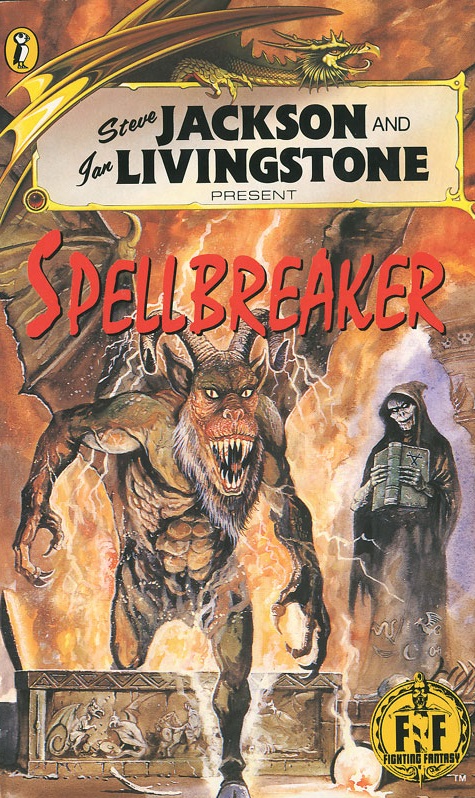
Spellbreaker
(FF53) was published 28 years ago this week, while its author, Jonathan Green, was still studying at university.

The story begins with the hero inadvertently enabling Nazek (another Warlock) to steal the Black Grimoire from its guardians at Rassin Abbey in the Old World kingdom of Ruddlestone. To make amends, the hero sets out to track down the villain in order to stop him from opening the legendary Casket of Shadows, and releasing the evil imprisoned within.

Art – both exterior and interior – was provided by Alan Langford. It was the first and last time the artist painted a cover for the series, despite having illustrated five FF adventures before Spellbreaker.

“They just asked me to do it,” says Langford, “which was rather nice, because you get paid rather more for cover art than you do for your inside work.” The image was produced using predominantly watercolours. “I used a little bit of permanent white gouache as well, which is my normal technique for watercolour.”

The Devilworm, which was inspired by the legend of the Lambton Worm.

One of the internal pen and ink illustrations provided by Alan Langford.

(© Alan Langford, 1993)

However, when Wizard Books republished the adventure in 2007, Martin McKenna was commissioned to produce a new piece of cover art, which was done digitally. (Green had been keen to have McKenna illustrate one of his FF adventures ever since being commissioned to write Spellbreaker, back in 1992.)


Despite being incredibly difficult to complete fairly, Spellbreaker still has its fans among the Fighting Fantasy community.

Did you know...?

It was John Sibbick’s image of a dragon attacking a band of adventurers, determined to steal its treasure hoard, that appeared on the front cover of Dungeoneer, that inspired Green to write Spellbreaker in the first place, because he thought the forward-facing dragon was actually a demon!


Friday, 23 April 2021

To Fighting Fantasy, or not to Fighting Fantasy?

In the region of your Earthly Plane known, slightly curiously, as the United Kingdom, today is Saint George's Day. 23rd April also just happens to be William Shakespeare's Death Day*.

Did you know that Fighting Fantasy author Jonathan Green is also an English scholar, with a fondness for the works of the Bard of Stratford? As a result, a fair few Shakespearean references appear in the Fighting Fantasy adventures he wrote between 1993 and 2010.
His first two books - Spellbreaker and Knights of Doom - were both influenced by 'That Scottish Play', Macbeth. For example, take the Bedlam Hags from the former, and the ghost of Sir Connor from the latter.

Shakespeare didn't make it into Curse of the Mummy**, but he was back in pirate zombie adventure Bloodbones, which features a sorcerer's cell on a desert island and a monster called Balinac.

Balinac, as realised by artist Tony Hough.

Howl of the Werewolf and Stormslayer are also free of the Elizabethan playwright's involve, but Night of the Necromancer probably has more Shakespearean references than any other gamebook by Jonathan Green, including numerous nods to Hamlet.

There is the name of the castle Valsinore (which is reminiscent of Elsinore castle in Denmark where Hamlet is set), the fact that the Hero can meet the ghost of their father, Lady Oriana is not unlike Hamlet's love interest Ophelia, and there's even a gravedigger called Yorrick!

Are there any other Shakespearean references that you've noticed in your favourite gamebook series?


* It may be his birthday too, but the only confirmed date at the beginning of his life is 26th April 1554, when he was baptised.

** Although Greek tragedy did.

Thursday, 31 October 2019

Friday, 1 June 2018

Ian Livingstone at the UK Games Expo 2018

In case you've been stuck in Deathtrap Dungeon since 1st May and haven't heard the news already, co-creator of the Fighting Fantasy series, co-founder of Games Workshop and all round gaming living legend, Ian Livingstone will be attending the UK Games Expo on Friday 1st and Saturday 2nd June.


On Friday 1st June, from 5.00pm to 7.00pm, in Toute Suite at the NEC, join Ian for a live reading of Deathtrap Dungeon and help raise funds for charity. Ian will be doing his best to lure intrepid adventurer, John Robertson - star of The Dark Room - to a horrible death, helped by the audience.

And then, on Friday 1st June, from 10.30pm to 11.30pm, in the Pavilion at the Hilton, the tables will be turned, and Ian will become the victim when he plays The Dark Room hosted by John Robertson.


Tickets for both the Deathtrap Dungeon live reading and The Dark Room, starring Ian Livingstone, can be purchased here.

On Saturday 2nd June, at noon in Toute Suite in the NEC, Ian will be giving a talk about the early years of Games Workshop and how the Fighting Fantasy series came to be, as part of the Expo's free seminar programme.


Gamebook author and historian Jonathan Green will also be in attendance and is marking 25 years since the publication of his first Fighting Fantasy adventure Spellbreaker with a special prize draw.

He will also have hardback copies of YOU ARE THE HERO Part 2 to sell.


Friday, 8 September 2017

The Second Swordsman – It’s Not Easy Being (the hero in a book written by Jonathan) Green

With Fighting Fantasy Fest over for another year (or two) it's back to business as normal here at www.fightingfantasy.com, which means it's time for another in Malcolm Garcia's Second Swordsman series. Enjoy!


The Second Swordsman – It’s Not Easy Being (the hero in a book written by Jonathan) Green

By Malcolm Garcia

After my previous trio of adventures, which were set in the all-too-familiar territory of Allansia, I crossed the ocean to see how the Second Swordsman process would fare in the Old World, the continent where the Sorcery! series is set and a land where I’ve so far feared to tread. And who better to be my guide than Jonathan Green who, although he penned his first FIGHTING FANTASY adventure in 1993, is still the most recent author to contribute to the world of Titan.


In Spellbreaker, YOU are trying to stop a horrible evil from being unleashed. In Stormslayer, YOU are trying to stop a jealous sorcerer from destroying the world with a horrible machine. And in Bloodbones, YOU are seeking vengeance upon the pirate who murdered your family and who might not be as dead as people believe.

So did the Second Swordsman process get me to 400 in any of these?

No.

In no particular order, I died during a battle against a much stronger enemy, died suddenly at the hands of a supernatural evil, and didn’t-quite-die but failed due to my stupidity. But despite these botched attempts, I did have some good adventures along the way.

Overall, in Green’s books, I got the sense that I was actually exploring the countryside during my quest, and not just slogging my way through a dungeon searching for magic objects while fighting every single creature I encountered. That’s not to say there wasn’t any fighting – in all three of these I had to fight something within the first couple of sections; some of which were quite strong for early stage enemies. But there are also whole towns and landscapes to explore with people I cannot attack who might either help me on my quest, or lead me to my doom.

Of these three books, my shortest-lived adventure as the Second Swordsman was in Bloodbones. My starting SKILL, STAMINA, and LUCK scores were good, I had a purse full of gold, and I was intrigued how the addition of a time factor would play out. I had an early fight with some pirates who might have been part of the possibly-undead Captain Cinnabar’s crew and then headed for the gambling halls of the Port of Crabs – which is possibly an even more perilous port than The Port of Peril. But then the process of choosing every second option made me ignore the games of chance on offer and I left with no more gold pieces than when I had arrived.

I continued to explore most of the city in my quest for clues and equipment. This resulted in me buying some weapons which held the promise of making future fights somewhat easier, but it also added much time to my tally. And when I decided to go and warn the Governor of the Port of Crabs about the risen Cinnabar, I foolishly chose not to bribe several people and ended my adventure prematurely, locked in a cell.

Spellbreaker was Green’s first FIGHTING FANTASY book and with its opening scene of monks and a fight against a demon it created an interesting Middle Ages atmosphere for the north-eastern part of the Old World in which it was set. The adventure sets me up with a deadline of four days in which I am to recover a stolen book that has been taken by a dark wizard to a nearby town so that he can raise a monster. But it soon becomes apparent that this adventure is not just about getting a book and that a larger evil is at work. However, once I left the monks I ignored a lot of opportunities to learn things – I didn’t escort a local noblewoman, I didn’t pay a jester at a local tavern, I didn’t buy a beer at a different tavern, I hurried through several small towns, and I didn’t take advantage of several opportunities to make offerings to various gods and martyrs – although when I finally did do this, I gained nothing.

However, I did get to fight a bear (without having to endure rounds of combat) and killed a Warlock and a local fiend called the Lurcher. I also found a local herbalist, one of the few helpful characters I met during my journey, who would have been even more helpful if I’d managed to collect a variety of plant life during my adventure. This encounter made me start to think that by taking every second option I had missed numerous potentially useful opportunities to find things. This feeling was confirmed when I failed to have two special objects in a row and suffered an instant death at the hands of a Wraith Rider.

And so to Stormslayer, probably the most enjoyable FIGHTING FANTASY book I’ve used the Second Swordsman process in since Battleblade Warrior. In this adventure I had some good starting scores, a decent supply of meals and gold, and a special dragon-slaying sword. As with Bloodbones and Spellbreaker this book throws you into combat at the very start – within the first few sections I’d fought a Manticore and an Ice Elemental. But these were not the only monsters I had to defeat during this adventure – my tally at the end being 22 (the same number that I faced in Battleblade Warrior). There was a good balance amongst these, some were weak creatures, others much stronger, and there were some melees (such as that against a trio of Naiads) that really wore down my STAMINA and made me grateful for my supply of food.

Early in the adventure I learned that a sorcerer named Balthazar Sturm has built a weather-altering flying machine that is powered by four elementals, and that to defeat him I need to travel across the western part of the Old World. The scope of this adventure is great. Sure, there are still some caverns where you need to choose between the left tunnel or the right tunnel. But you also choose where in the Kingdom of Femphrey you want to travel. And when you do travel long distances you need to keep track of the day of the week; arrive in a place on a certain day and your enemies will have temporarily become more powerful.

In a welcome change, using the Second Swordsman process in Stormslayer did not mean that I ignored everything. Through it I gained the much-needed assistance of a Dwarven brewer when journeying through the Witchtooth Mountains. And, in one of my favourite sequences of the book, when I chose every second option while journeying underwater, I set two massive aquatic monsters against each other rather than becoming a snack for either one of them. But eventually my adventure ended; killed by a Fire Elemental in a cavern deep beneath Mount Pyre. I was already suffering an imposed loss of two SKILL points and only scored one hit against it. So unfortunately I never got to find Sturm’s flying machine, or even use the dragon-slaying power of my sword.

While the Second Swordsman met with universal failure in my escapades in the Old World, in these three books by Jonathan Green it did provide me with some enjoyable adventures. I didn’t make too many obviously stupid decisions; I didn’t miss each and every opportunity to collect some valuable information or gain a special object; and, while I still ignored a lot of chances to explore, this didn’t make the books boring. I’ll look forward to trying the process on some more of Green’s adventures later on. Although maybe not Knights of Doom – I don’t fancy taking out another mortgage right now.