Showing posts with label Guest Post. Show all posts

Friday, 3 August 2018

The Second Swordsman – Your Adventure Ends Here (Part 2)

Last week we presented the first part of Malcolm Garcia's 17th and final The Second Swordsman post. And now it's time for Part 2...


The Second Swordsman – Your Adventure Ends Here

By Malcolm Garcia

At the start of last year I decided to test an idea – could I complete any FIGHTING FANTASY adventure by always choosing the second option? Many of the books in the series are notoriously difficult, punishing even the slightest deviation from the ‘one true path’ with an instant death or worse, not finding an essential key or jewel.  But would the path to success ever be something as elementary as always making the second choice? Only the authors of those books would know, but could I discover their secret?

Having attempted 47 of the books in the series, the conclusion I’ve come to is (perhaps unsurprisingly) ‘no’. However, although every one of these adventures ended in my failure to find the treasure, protect myself, or kill the ‘Big Bad’ and save the world, I did find a lot of enjoyment and learned a few things along the way.

(To read Lessons 1-3, follow this link.)

Lesson Four. It’s not just about SKILL and STAMINA. For much of my adventures, by choosing every second option my goal was just to stay alive. This meant defeating every creature I came across, relying on my own SKILL and STAMINA to be better than theirs. But in many FIGHTING FANTASY books there was more to it than that. As early as Citadel of Chaos there were often extra attributes to take into account that could help or hinder your journey.

In Citadel of Chaos I chose to take every second spell available, which meant I took several duplicates with me into Balthus Dire’s fortress. Because I lasted a while in this book I actually managed to use a number of these (including burning through all of my Levitation spells), although I’m unsure whether I took the right combination with me from the very beginning. Phantoms of Fear also gave me the ability to use magic, in the guise of the POWER score. Alas, I barely managed to use this, casting just one fire and one weaken spell. On the other hand, the FAITH score in Vault of the Vampire enabled me to avoid fights against several creatures and probably some unsavoury situations, and in Howl of the Werewolf the CHANGE score gave me some useful abilities to turn me into an almost unstoppable killing machine towards the end of the book. While on the subject, the ability to instantly kill an adversary in Creature of Havoc added to the enjoyment of this adventure, and I wish I’d seen it used more often than just the five times in the nine fights I had.

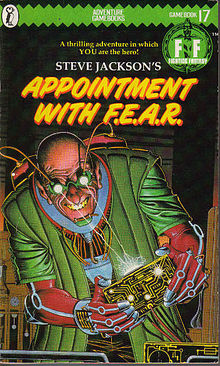
In two of the gamebooks written by Stephen Hand, Moonrunner and Dead of Night, YOU are given the opportunity to personalise your character by choosing from several Special Skills, and in Midnight Rogue, YOU can also choose what specialities your thief has trained in. This provided a new dynamic to the books as it was no longer a matter of just choosing the second option; the second option had to be something YOU are able to do. As with Citadel of Chaos I was unsure in these books whether choosing the wrong skills even before section one dooms a player to failure. When I tried Appointment with F.E.A.R. my chosen skills not only turned out to be useless, but I ended up being killed by my own energy blast.

In other adventures an extra factor can work to make success that much harder. In most of the books with these I didn’t live long enough to notice any effects. But in Daggers of Darkness the poison that I am inflicted with by the assassin in the prologue seemed to be spreading rapidly through my body, mainly because I was constantly physically exerting myself throughout the course of the adventure in combat. Of a maximum allowed POISON score of 22, I had gained 15 points by the time I failed – and I was nowhere near the end. The most memorable complicating factor I encountered was, of course, House of Hell’s FEAR score. Set by the initial whim of a dice roll, relentlessly accumulating, and likely to be accrued at almost any time, the FEAR factor must surely narrow the path to victory in a book where YOU already start with a SKILL penalty for being unarmed. In my attempt at this book I was only one FEAR point away from being scared to death when I failed, and I was nowhere near escaping.

All of this is not, of course, to ignore the other third of the three main character characteristics – LUCK. In general, the longer I lasted, the more I tested my LUCK. I underwent six LUCK tests in each of Battleblade Warrior, Legend of Zagor and Seas of Blood (where failing the final test had me crashing into an iceberg and dying). I also used LUCK during every round in my fight against the Basilisk in Night Dragon – which also killed me when the dice went against me and I was petrified.  However throughout my long-lived adventure in Howl of the Werewolf I only tested my LUCK twice. And I only used this factor three times throughout Stormslayer and twice in Stealer of Souls. Even in The Forest of Doom I was able to cross Darkwood Forest from north to south and only tested my LUCK twice.

As mentioned above, failing a LUCK test did bring about my demise in Seas of Blood and Night Dragon. I also failed the second LUCK test I had in Forest of Doom and was torn to shreds by a hail of arrows. The other adventures where a failed LUCK test sealed my fate were Crypt of the Sorcerer (where I was thrown from my horse and knocked unconscious), Tower of Destruction (where, during my exploration of the interior of a mysterious flying ball, I was unable to avoid a fire trap which burned off my remaining STAMINA), and Scorpion Swamp (where in my rush to explore the swamp I fell into a muddy hole and disappeared).

Lesson Five. Taking the second option doesn’t mean having a second-rate adventure. In the FIGHTING FANTASY books where I survived beyond a few choices, the series’ authors were able to create story worlds where I actually cared about the fate of my character and felt as if they were part of a larger world, either through the physical scope of the book, the importance of the quest, or the ability to interact with the locals.

Gathering McGuffins on dungeon crawls can be notoriously tiresome, but in Creature of Havoc even though I often had little control over my destiny, the sheer volume of fights I had and the one-hit kill ability made this into an enjoyable adventure - who doesn’t like eating hobbits for a snack? Although I ignored plenty of opportunities to explore some of the trees, caves, taverns and shops in both The Forest of Doom and City of Thieves, Darkwood Forest and Port Blacksand seemed to be places where a whole ecosystem of characters existed, independent of my presence.

While above-ground, there were several notable adventures where the author created the sense that I was moving across a much larger world, if I survived for long enough. This was certainly the case in the aforementioned Battleblade Warrior where I crossed the entirety of the included map in the one attempt. The ‘hub’ design of Stormslayer allowed me to choose which part of Femphrey I would explore first, with progress from one place to another taking several days, but without getting bogged down in minute choices. Midnight Rogue had a similar mechanism and did not force me to decide which individual street of Port Blacksand I should follow. Although, as with Stormslayer, I’m unsure whether, in spite of this apparent freedom, each place needed to be visited in a specific order to be successful.

In every FIGHTING FANTASY adventure the odds are stacked against success, particularly when subject to the self-imposed constraint of always choosing the second option. And in a good number of these books the writers have created a delightfully depressing atmosphere where YOU feel that the whole world is against YOU. One of my favourite examples of this was Moonrunner. As soon as the adventure began, with the death of my boss, there wasn’t a moment when I felt as though anyone in Blackhaven was going to actually help me. In Dead of Night the demonic blight that had settled over Gallantaria gave the book a medieval grimness, a sense that I also found in Spellbreaker (although I didn’t exploit many of the opportunities to interact with the locals). And once my character entered the diseased forest in Phantoms of Fear I knew I would be completely on my own as I descended into the underworld of the Demon Prince Ishtra.

What also created a great sense of atmosphere in several of the FIGHTING FANTASY adventures was knowing that I was not the only person in the world. In some books the NPCs were an important part of the story, not just an opportunity to test your swordsmanship, and how YOU interacted with them would directly affect your chances of success. In Legend of the Shadow Warriors an NPC brought about my failure because I’d failed to pay my taxes – and I never had an opportunity to run him through! In Dead of Night and Howl of the Werewolf I moved from depressing village to depressing village, and the locals would likely have helped me in my quest had I bothered to assist them, even just a little bit. Both Midnight Rogue and Moonrunner were set in cities and, partly to avoid attracting unwanted attention, I could not just attack every living thing in sight. But my favourite adventure with NPCs would have to be Vault of the Vampire. Within Castle Heydrich there were a few people who were just as keen to see the end of the Count as I was, and so they were willing to help, in varying degrees (although this did not stop the Second Swordsman process from having me kill one of them in cold blood).

My adventure ends here.
As I only attempted 70% of the FIGHTING FANTASY series by choosing the second option, I remain hopeful that in one of the other books the Second Swordsman process could lead to ultimate success. And while I did experience universal failure, in varying degrees, I was also entertained numerous times over the past seventeen months. I chose the right weapon to tackle the Bonecrusher Beast, rescued and used a genie, was saved from a pirate ship by seagoing dwarves, had a nap in a dungeon, was turned invisible by a witch, collected a tapestry, was guided underneath a volcano by a dwarven brewer, set a pair of gigantic aquatic monsters against each other, and got out of an abandoned city by catapulting myself into the ocean. My adventure might end here, but there are still plenty of stories of orc, dragons, treasure and magic to entertain readers everywhere.


A huge thank you to Malcolm for his hard work over the last 17 months. If you have enjoyed his Second Swordsman posts, you may be interested to know that Malcolm's debut novel is out now.

Remember, if you have an idea for a guest post, or even a series of posts, you can contact the Warlock at mail@fightingfantasy.com.

Friday, 27 July 2018

The Second Swordsman – Your Adventure Ends Here

Today is a momentous occasion, for today we present, for your delectation, part one of Malcolm Garcia's 17th and final The Second Swordsman post, entitled...


The Second Swordsman – Your Adventure Ends Here

By Malcolm Garcia


At the start of last year I decided to test an idea – could I complete any FIGHTING FANTASY adventure by always choosing the second option? Many of the books in the series are notoriously difficult, punishing even the slightest deviation from the ‘one true path’ with an instant death or worse, not finding an essential key or jewel.  But would the path to success ever be something as elementary as always making the second choice? Only the authors of those books would know, but could I discover their secret?

Having attempted 47 of the books in the series, the conclusion I’ve come to is (perhaps unsurprisingly) ‘no’. However, although every one of these adventures ended in my failure to find the treasure, protect myself, or kill the ‘Big Bad’ and save the world, I did find a lot of enjoyment and learned a few things along the way.

Lesson One. Curiosity might kill the cat, but a lack of it won’t help much either. In nearly every FIGHTING FANTASY book, choosing the second option meant I ignored opportunities to find treasure, discover special objects, or learn something that could help me in my quest. Just how much ignoring I did depended on the mechanics of the book. Where the choices were between doing something, or not doing something, there was a tendency for my character to race through the adventure, hoping that just getting to the end with my sword would be enough.

The very first adventure I tried to complete using the Second Swordsman method was The Warlock of Firetop Mountain, and during this attempt I blitzed past a total of nine doors. While some of these would have almost certainly contained dangers, and so I may have lived a little longer by avoiding them, I also gained nothing to help me later on. A similar fate befell me when trying Eye of the Dragon and Armies of Death where I, respectively, ignored a total of 13 doors and raced across northern Allansia to find Agglax without making any attempt to supplement the size of my eponymous army.

The Second Swordsman process also resulted in me racing across Stayng Island, in Keep of the Lich Lord, seemingly determined not to let any interesting caves or cemeteries distract me from reaching my goal, and I hurried through Port Blacksand when trying City of Thieves, ignoring all sorts of opportunities for adventure. In the one space-based FIGHTING FANTASY adventure I tried, Starship Traveller, following the process of choosing the second option led to me zooming from planet to planet, but nearly every time I decided not to beam-down and investigate (although when I did, I enjoyed killing the local fauna for food), but to instead travel to the next planet.

In both of my attempts at completing water-based adventures, using the second option meant I forwent several chances for diversions. In Demons of the Deep I avoided assisting the spirit of a sea captain and a dolphin being attacked by a shark and I never managed to learn anything about the black pearls and how they could be used to help me seek revenge. In Seas of Blood I made few attempts to find significant sources of treasure, such as not visiting the Dead City or exploring the Island of the Roc, and I seemed to focus more on the time limit part of the challenge with Abdul the Butcher, which meant that I hurried to my doom.

On other occasions the choices were set up to do either one thing, or do something else entirely. This was the case in Howl of the Werewolf. On almost every occasion where I was given the choice between embarking on a side quest, or pursuing my quarry, I chose the latter. Although this probably allowed me to live longer it also almost certainly kept me from some interesting encounters. On another adventure in the Old World, Dead of Night, I chose not to stick around and purify the graves of my parents and decided not to help some grieving villagers.

In some books there would be a ‘hub’, from where I could take turns to choose different sections of a location to explore, although I’d often then ignore most of the opportunities in each particular section. In Legend of Zagor the design of the adventure meant I probably visited every room in Castle Argent, but I didn’t subsequently search them with any vigour. And while looking for the mystery behind the Island of the Undead I went to most places on the island, but when given an opportunity to investigate closely, my usual choice was to move on quickly to the next location.

Lesson Two. It’s called FIGHTING FANTASY for a very good reason. As mentioned above, all of my attempts at success by choosing the second option met with failure. And of those 47 attempts, on 11 occasions my death came about by fighting one of the very many creatures in the FIGHTING FANTASY universe. In just under half of these, I lost my life in a battle against an enemy that had a SKILL score of ten or greater; these probably account for less than 15 per cent of all FIGHTING FANTASY creatures. The Fire Elemental in Stormslayer was not only strong, but while under Mount Pyre I was impeded by a two-point SKILL penalty, which made defeat almost inevitable. Legend of Zagor’s SKILL twelve Thief was an unusual encounter that in hindsight I feel should have been avoided. The same goes for the Giant Sandworm in Temple of Terror, unless I missed a SKILL-enhancing weapon. The Kraken in Demons of the Deep had the added complication of an almost insurmountable STAMINA score of 30. Against the Doppelganger in Eye of the Dragon I should have had a chance, if not for some poor dice rolls and a two point SKILL penalty.

However it didn’t always take a strong enemy to best me. There were some fights I just wasn’t meant to win. Beneath Castle Heydrich, in Vault of the Vampire, my SKILL was inhibited by two in a fight against the Stench Ghoul, and so it ate me. Although I managed to find the Minotaur in The Warlock of Firetop Mountain’s labyrinth, the dice went against me one too many times, as it did in a skirmish against a Baboon in Curse of the Mummy and a Knight in Fangs of Fury. The Fighting Slave in Trial of Champions was just dastardly, particularly since there were no opportunities to recover STAMINA from my earlier trials. And in Phantoms of Fear I was defeated by the worst enemy of all – myself.

Although when I lost a fight, it was often against a powerful enemy, I also defeated my fair share of strong creatures.  Both the Swamp Mutant and Warrior King didn’t survive their encounters with me in Battleblade Warrior. Nor did the Fog Wyvern and Skeletal Dragon in Legend of Zagor. I lasted long enough against the Kauderwelsch Monster in Moonrunner to be rescued by a prison riot. While I didn’t last long in Chasms of Malice, I did take out one of the seven Khuddam before I fell and I bested the Easterner in Trial of Champions. The Sith Orb, in Seas of Blood, remains one of the strangest encounters I ever had, but while it was strong, I was stronger. And in Caverns of the Snow Witch, I faced and defeated the big three of the Yeti, the Frost Giant, and the White Dragon. And while it didn’t have a high SKILL score, I still detest the Vampire Weasel for its endless series of cheap shots that drained seven of my STAMINA points in Vault of the Vampire.

In some of the later adventures in the series I noticed that the book’s authors added more fights earlier on. Whether this was to get the reader accustomed to the combat process sooner, or to weed out weak characters is unclear. But in Howl of the WerewolfStormslayerBloodbonesSpellbreaker and Curse of the Mummy I had battles within three choices of section one (coincidentally these were all written by Jonathan Green*). Caverns of the Snow Witch was the first book in which I noticed this early-combat element (against the Mammoth), but it was also used in Phantoms of FearStealer of SoulsTower of Destruction and Island of the Undead – the latter three being authored by Keith Martin.

Usually the longer I survived, the more fights I would have. In Battleblade WarriorHowl of the Werewolf and Stormslayer I faced off against 22 individual enemies. While in Legend of Zagor and Phantomsof Fear I had 16 such encounters. A noticeable exception to this was that while I didn’t very last long in Creature of Havoc, I did manage to fight a total of nine creatures.

Lesson Three. Choosing the second option doesn’t mean dying within seconds. Yes, choosing the second option led me to an instant death within one choice in Beneath Nightmare Castle – but it was a memorable ending! And I was dead within two choices in Master of ChaosScorpion Swamp and Crypt of the Sorcerer. But in the last two of that trio it was a failed LUCK test that killed me instantly. And within four choices I’d failed in Island of the Lizard King as I made a cowardly run from the Giant Crab that had grabbed poor Mungo.

But the second option didn’t always doom me to an early end. And when I did get a long way, my failure was usually from one of the aforementioned difficult fights, rather than an instant death. Unfortunately, when I did get a long way, because I’d usually ignored things along the journey it was unlikely I’d have what I needed to get closer to the end, or to win. Having said all that, I came so very close to victory using the Second Swordsman process in two of the 47 FIGHTING FANTASY books I attempted.

In Battleblade Warrior, I fought my way through the siege of Vymorna, survived the perils of the plains and jungles beyond (by riding on a lizard, battling a dozen lizard men, and visiting an orc funeral), and journeyed into the lost city of Kharnek, and found part of the mystical sword I had been seeking. After slaying the Warrior King I left aside his jewelled crown and kept going. But because I inexplicably ignored that jewel, I was instantly killed by a traitor within sight of the end.

After being attacked at the very start of Howl of the Werewolf I battled my way across Lupravia, usually sticking to the path which would lead me Castle Wulfenstein. Along the way, amongst other things, I stayed clear of a local carnival, participated in a futile beast hunt, and ignored a creepy hole in the basement of a crypt. I also picked up some useful were-skills that helped me in the numerous fights I had. When I arrived at the castle I slew everyone in my path and bested Count Varcolac. But he then came back to life in demon form and, because I didn’t find the sword that was hidden deeper in the crypt I’d avoided earlier, I was instantly killed.

Along with the aforementioned early failures, choosing the second option did give me some other memorable instant-deaths. In Starship Traveller I captained my crew into a black hole from which we never re-emerged, and in Masks of Mayhem I walked into some fog and disappeared from the face of Titan forever. In Moonrunner I succumbed to a poisoned letter, and although Deathtrap Dungeon is renowned for being filled with a multitude of fiendish traps and beasts, I failed because I ate some fungus that made me grow bigger. While searching for a medallion in another labyrinth, this one in Daggers of Darkness, having to roll a dice too many times resulted in me being impaled by a spear trap. And in House of Hell following the second-choice path meant that I chose to go into the kitchens where, although I finally found a weapon, I was set upon by a ghoul who I killed, but not before the residents of the house were alerted to my presence and I was captured, to be subjected to an unspeakable fate.


As stated at the start of this post, Malcolm's final Second Swordsman post is so long that we will be publishing Part 2 next week. So don't forget to bookmark this site and make sure you're here in seven days' time...

* Or perhaps un-coincidentally - The Warlock.

Friday, 28 April 2017

The Second Swordsman - 'The Jackson Three'

This week it's time for another of Malcolm Garcia's Second Swordsman posts. Enjoy!


The Second Swordsman – 'The Jackson Three'

By Malcolm Garcia

So far I’ve attempted to complete ten FIGHTING FANTASY adventures by unfailingly choosing the second option. But I’ve noticed that something has been amiss. It’s not that I’ve yet to be successful in reaching section 400 (I’m accustomed to that), or that I’ve died within a few paragraphs of starting (that’s only happened a couple of times), or even that I’ve not managed to fight any gruesome creatures (I’ve done that a few times too). No. What’s been wrong is that of all my adventures, five have been solo efforts by Ian Livingstone, but only one – The Citadel of Chaos – has been the work of the co-founder of the FIGHTING FANTASY series, Steve Jackson.

To redress the balance I embarked upon using the Second Swordsman process to tackle three of Steve Jackson’s adventures. (No, it’s not the Sorcery! series, yet.) Interestingly, none of these is set in the familiar territory of Titan. Starship Traveller has YOU in a Captain Kirk-esque role, trying to guide your spaceship and crew back to Earth after being pulled through a black hole. House of Hell has YOU attempting to survive being captured by a group of devil worshippers in the world’s worst haunted house. And in Appointment with F.E.A.R. YOU are the resident superhero of Titan City who is trying to serve truth and justice, whilst also trying to uncover just enough clues to disrupt a meeting of super-villains.

Refreshingly, choosing every second option did not lead to a sudden and inglorious death in any of these three adventures. Despite acting in a gung-ho manner in Starship, I survived for a surprisingly long time. I destroyed two other spaceships (using a process much more complicated than that in Seas of Blood, but for no gain), killed local fauna for food, drew my blasters on alien species, and beat up guards. This foolhardy approach did, however, leave my own spaceship only one laser blast away from destruction. It was good having several crew members join me in my attempts at hostile negotiations and I never lost a single red-shirted one of them; until towards the end when several of them lost all hope of rescue and committed suicide. And then I went into another black hole and everyone died.

Fighting was not quite so successful in House. When following the process I failed to find a weapon for a long time and lost three rounds in unarmed combat against the appropriately named Invisible Enemy. I did manage to find a knife just in time to fight a Ghoul in the kitchen. But by this point I was only one FEAR point away from being scared to death and, even though I beat the menace without losing a single STAMINA point, I made such a racket that I was captured by the inhabitants of the house and placed in a cell to await a horrible, and unspecified, end. I thought the addition of the FEAR statistic was interesting, as I had to rely less on my LUCK (which I only had to test once), but it did provide an immediate penalty to any wrong turn in a way that other FIGHTING FANTASY books don’t.

In Appointment I fought only one character, a pickpocket, and this was in a city teeming with super-villains! I’ll admit right now that, even with all of the punishing names of characters and places, I did not enjoy playing Appointment. While I survived a few days (helped by being able to replenish six STAMINA points every night), and knew what I ultimately needed to do (unlike in Demons of the Deep), I found the adventure to be very disjointed. Each day I would be given the choice of visiting several different places, almost on a whim, with no real sense that I was gradually getting closer to my goal. The process in Midnight Rogue was better with all the locations being presented up front and then YOU choose the order in which to investigate them. I was also unsure about the purpose of the HERO points. In House, when your FEAR score reaches its maximum you die. But in Appointment there didn’t seem to be a penalty for losing HERO points or a benefit to be gained from accumulating them. There was also an unusual scene in Appointment where I faced off against a super-villain who was about to destroy a nuclear reactor. My initial attack against him was rebuffed and I then fled the scene, but nothing happened to the nuclear reactor! And my last gripe with Appointment was that the Energy Blast skill I chose was worse than useless – I used it three times and it failed twice, the second time resulting in my own death.


The only good thing about Appointment was that choosing the second option every time did not have me ignoring everything. The usual options were to go to one place or another. This meant I was able to stop a plane hijacking and rescue some swimmers from a frozen pool. But while not ignoring things meant I learned a lot about the plans of other criminals, I was never able to actually use this knowledge.

The situation was different in Starship where, even though choosing every second option let me survive for a long time, I fell into a cycle of ignoring most opportunities – I orbited a lot of planets, but then I ignored most of those with intelligent life. I only beamed down a few times, and when I did get to the surface I always seemed to be in a hurry to get back into space. The result was that I never really learned anything about the galaxy I’d found myself in, or how to get back to Earth. I even ignored the one opportunity to repair my ship, and this was after I’d been pummeled in the aforementioned space battles, as well as by a storm of meteors.

In House, even though I ignored a multitude of places to explore - for old times’ sake I would have loved to check out the Balthus room – it probably had the Ganjees! - I didn’t ignore absolutely everything. But this meant I gathered FEAR points way too quickly to have a good chance of finding the golden path through the labyrinth. One area in which House certainly shone was atmosphere. As soon as you start reading you get the feeling that coming here was a bad idea – in other FIGHTING FANTASY adventures your character usually knows what they’re getting themselves into. There was a growing sense of dread as I waited for the adventure to turn from me being a house guest of some local aristocrat to fighting for my life as a prisoner of some fiends. This wasn’t lightened by the interesting choose-your-own-banquet sequence and it’s no wonder that House was rated in the top ten FIGHTING FANTASY adventures in a fan poll several years ago.

So, although attempting ‘The Jackson Three’ using the Second Swordsman process didn’t see me slain by an ogre or fail to collect an important artefact upon which the fate of the world rested, I still fell short of reaching section 400 (or 340 and 440 in Starship and Appointment respectively). Next time I’ll grab my trusty sword and shield and seek out monsters, magic, and expanding mushrooms back on Titan.


Thank you, as always, to Malcolm, for his latest Second Swordsman blog post. If you have any suggestions for items for the official Fighting Fantasy blog don't forget to get in touch via mail@fightingfantasy.com.

Friday, 7 April 2017

The Second Swordsman – ‘All at Sea!’

It's been a couple of weeks since Malcolm Garcia's last Second Swordsman post, but then it's been a busy couple of weeks for Fighting Fantasy, what with the announcement that the series is coming back with Scholastic UK, the announcement the Nomad Games are making Fighting Fantasy Legends, and the funding of the YOU ARE THE HERO Part 2 Kickstarter. But now he's back, and this time Malcolm is...


The Second Swordsman – ‘All at Sea!’

By Malcolm Garcia

After my previous, and universally unsuccessful, adventures across the cities, forests, and dungeons of Titan I decided to see if choosing every second option would lead me to glory on the open ocean. In Seas of Blood (written by Andrew Chapman) YOU face off against your nemesis in a pirate-captain-showdown to see who can get the most treasure in fifty days while terrorising the Inland Sea of Khul. While in Demons of the Deep (written by the American Steve Jackson) YOU are the intended victim of a different pirate captain who casts you overboard, not knowing you would discover the underwater city of Atlantis and plot your revenge.

By dutifully following the Second Swordsman process, I made a poor start in both Seas and Demons. In the race-against-the-clock that is Seas, I eschewed the traditional pirate business model of plundering all manner of vessels and, after leaving the city of Tak (whose reputation makes it somehow sound worse than Port Blacksand), I instead went and hid in the desert for three days. After I gave up waiting for a caravan that never came, I headed to sea, only to then decide that the best way to make some serious loot and win this competition was to go… gambling. These two decisions resulted in a big waste of time for very little treasure gained.

And in Demons, while I didn’t stupidly try to immediately return to the pirates who had pushed me overboard, I did start my adventure in Atlantis by declining to help the spirit of a sea captain, swimming away from a Grouper (which bit me anyway and cost me two STAMINA), ignoring a crown and a trapdoor in a mausoleum, and then not helping a dolphin while it was being attacked by a shark (which lost me one STAMINA and one LUCK). If there was ever a time that an adventurer did not deserve the epithet ‘You Are The Hero’, this was it. I also didn’t explore a sunken ship or seek out a Sea Dragon for help against the pirates. Indeed, throughout my whole adventure in Demons I never actually found out what I should be doing; a few people mentioned that black pearls were important, but I wouldn’t have known what to do with them even if I had any.

In Seas there was only the one occasion that the Second Swordsman process earned me some serious booty. Because you have a ship’s crew, you can take on entire towns and other enemies that would usually be too much for one adventurer to fight. This meant we were able to sack a small town and steal its treasure. But I only did this once (I’m not quite sure why fighting the gambling pirates in Calah didn’t become a crew fight) and never had the opportunity for a good old-fashioned ship-to-ship fight. For most of Seas I ignored opportunities to get some gold and win the contest with the rival pirates. I left the desert after only a few days, I didn’t push onwards to the Dead City, I decided not to hunt for ships, I didn’t explore the island of Roc after killing the Roc, and I turned down the opportunity to attack the fishing town of Kirkuk (isn’t that in Iraq?).

In Demons, choosing the second option got me into some perilous fights. A Sea Ogre took half my STAMINA to beat it and fighting the Lion Fish cost me eight STAMINA. I also fought the aforementioned Grouper, but that wasn’t very exciting. However both the Grouper and the Lion Fish attacked me while I tried to initially flee from them and I lost STAMINA as a penalty, without even testing my LUCK. The only time fleeing worked without being penalised was against the much slower, and probably tastier, Giant Crabs. While exploring Atlantis I also had to take on the Kraken and, with a SKILL of 10 and STAMINA of 30, this was the beast that killed me. Other than a dragon or demon, this must be one of the highest STAMINA scores in all of Titan and I think I’d have needed a SKILL of 12 (or an enchanted weapon) to stand even the slightest chance against it.

Other than the fight against the gambling four pirates, in Seas, the only other creature I fought was the Sith Orb. While I know that Titan is a place full of mystery and monsters, I genuinely did not expect to encounter such a monster in, what appeared to be, a quiet farming town. Whatever happened to the locals using some wild dogs, or even a bear to guard their treasure? And how did those townspeople even get their hands on a Sith Orb in the first place?

In Seas, choosing the second option every time meant I had to test my LUCK six times, and it was the final (and inevitable) unlucky roll of the dice that doomed my crew faster than you can say ‘iceberg ahead’. Conversely, in Demons, I never once had to test my luck. I probably could have done it in my epic battle against the Kraken, but I doubt it would have changed the outcome.

So, once again, the Second Swordsman has met with failure, my body left to drift at the bottom of the ocean, probably being picked to pieces by those Giant Crabs. Maybe next time I’ll stick to adventuring on dry land.


Thank you once again, to Malcolm, for his blog post, and don't forget to get in touch if you have any suggestions for items for the Official Fighting Fantasy blog via mail@fightingfantasy.com.

Friday, 17 March 2017

The Second Swordsman – ‘Beware Blacksand!’

A few weeks ago we presented the second in Malcolm Garcia's series of Second Swordsman blog posts. Well he's back, and what with the collector's edition of City of Thieves currently funding on Indiegogo, and Ian Livingstone revisiting the port later this year in his new gamebook, it is rather appropriate that Malcolm's new piece is entitled...


The Second Swordsman – ‘Beware Blacksand!’

By Malcolm Garcia

With the possible exception of Fang’s Deathtrap Dungeon, there is unlikely to be a place in all of Titan as infamous as Port Blacksand. Nestled on the western coast of Allansia, astride the Catfish River, Port Blacksand is mentioned in several Fighting Fantasy adventures, usually in unflattering terms. But for two of the books, Port Blacksand is the main place where you, the adventurer, will spend much of your time attempting to complete your quest (while trying to avoid being killed or becoming ensnared).


In City of Thieves Port Blacksand is where you seek out the wizard Nicodemus for his advice, and thereafter you rummage through the city searching for the various objects on Nicodemus’s shopping list. In Midnight Rogue you are a wannabe thief and the port is yours to explore as you attempt to discover the hiding place of the gem known as the ‘Eye of the Basilisk’; finding it is essential if you want to be welcomed into the Port’s Guild of Thieves, for which you have apparently spent several years in training.

So, did the Second Swordsman process result in success in either of these quests?

No.

Again.

However, as has happened in a few of my adventures, consistently choosing the second option made my journey last a surprisingly long time. Also on the positive side is that at the end of both City and Midnight my character was still alive, and not a meal for a creature, or variously crushed, impaled or poisoned by a trap. However I was burdened, respectively, with the heavy shame of letting down the people of Silverton and failing to join the Thieves' Guild. In City I managed to meet Nicodemus (for a man hiding away from folks, he was easy to find) and escaped the city guard, but once outside the city walls I realised I’d failed to gather any of the special items I needed to defeat Zanbar Bone. And in Midnight I did manage to find some information about where the Eye of the Basilisk was hidden during my skulking across the city, but I didn’t gather enough clues and so failed. (Can anybody else figure out how the Guild of Thieves has so many members when the entry test is so difficult?)

In both City and Midnight I had the enjoyable feeling of exploring a large city, rather than crawling through a dungeon or lurking in the corridors of a castle. Despite this, City pushes you constantly forward, giving opportunities to visit various places of interest along the way but with no possibility of going back and exploring streets you haven’t already walked along; which is never the best environment for the Second Swordsman method. On the surface Midnight doesn’t have the same pacing and you’re given the option of sneaking around and visiting places right across the city, in a non-linear manner. But, once you’ve been to an area, you cannot return later – you must gather whatever you need in the one visit and then go somewhere else. Though there are some welcome, if rare, occasions when, if you ignore an option the first time, you’ll later be given the option to do so again.

In City, the Second Swordsman process made for an inauspicious start – the first thing I did upon arriving in Port Blacksand was to flee from one of the city guards. I then chose to ignore both a herbalist and a tavern, surely staples of any adventure. After pelting eggs at a man in the stocks, I then ignored a clairvoyant (although if they were any good they would have known I’d do that) and I ignored a house with skulls painted on the door, but there may well have been ne’er-do-wells in there - this is the City of Thieves after all!

I also ignored a warty man, some other men fighting, a manhole cover, a beggar, a beguiling alleyway, a candle maker and a silver smith. I even ignored the opportunity to check out a pirate ship – as good as any place to find the mysterious items I needed for my quest. While some of these would have undoubtedly led to hostile encounters, not investigating any of them made me less hopeful I’d find what I needed to defeat Zanbar Bone. I did take a break from ignoring things for just long enough to return a convicted murderer into the hands of the city guards, but I then ignored some, almost certainly, interesting gardens (the City of Thieves would never have uninteresting plant life).

In Midnight, the Second Swordsman process did not have the same ignoring effect; maybe because it’s one of the later books in the series and the choices had, by then, evolved beyond the basic ‘do’ or ‘don’t do’. Constantly choosing the second option didn’t make me do anything dangerously stupid – even though I did explore some places that I wouldn’t usually have chosen – and it helped me gain the skill to hide, defeat a gargoyle, and find the aforementioned clue about the location of the precious gem.

Midnight has been the first book I’ve attempted using the Second Swordsman process that has required me to select various skills before starting and I found this a welcome addition. Even though I had to choose every second one available, I found what I selected to be generally very useful. When compared to The Citadel of Chaos (where I burned through my levitation spells in short order but never used some others I had chosen) the process of having an ability for the duration of the book was enjoyable. As was the possibility of gaining extra skills.

Unlike Caverns of the Snow Witch and Trial of Champions, neither City nor Midnight confronted me at an early stage with any especially difficult enemies. In City my only fight was with the most apt of enemies – a pair of thieves. And in Midnight, in a serious case of collateral damage, I made short work of the poor guard and footpad (why aren’t they members of the guild?) who got in the way of me passing my exam.

For now though, I’ll shuffle off into the wilderness of Allansia, head held low in shame but always seeking out the next adventure for the Second Swordsman.


Thanks again, to Malcolm, for his blog post, and don't forget to get in touch if you have any suggestions for item for the Official Fighting Fantasy blog via mail@fightingfantasy.com.

Friday, 24 February 2017

The Second Swordsman – ‘The Walks’

Last week we presented the first in Malcolm Garcia's series of Second Swordsman blog posts. Such was the positive response that this week we have the second blog in the series. So, over to Malcolm...


The Second Swordsman – ‘The Walks’

By Malcolm Garcia

In my first attempts at using the Second Swordsman process to successfully complete a Fighting Fantasy adventure, I failed in each of the first three books. The process of always choosing the second option resulted in me dying in a variety of ways, occasionally while tantalisingly close to my goal. For my next couple of attempts I decided to revisit one of the most famous adventures (if only by virtue of its cover), Deathtrap Dungeon and the V2.0 version of it, the Trial of Champions, both were written by Ian Livingstone CBE. The first published in 1984 and the second in 1986, so I was hoping that his temperament would have eased over those two years to give me a decent chance of success.

Or not. Once again when following every second choice I failed in each of my adventures and both deaths were also somewhat disappointing. In Deathtrap I foolishly chose to eat some strange mushrooms I found in a cellar. They caused me to swell dramatically in size (similar to Violet Beauregard in ‘Charlie and the Chocolate Factory’) and I became stuck in there, apparently forever. (Don’t cleaners ever visit the dungeon to remove the remains of unsuccessful competitors?) And in Trial I eventually fell victim to Lord Carnuss’s meat-grinding-series-of-trials after having to fight one-slave-too-many and I died on Blood Island without even managing to enter the new dungeon.

In Deathtrap, unflinchingly choosing the second option still had me ignoring many potentially useful things, such as a skeleton holding some parchment – seriously, in a creepy labyrinth I ignored parchment! – a box with my name on it, a giant idol with jewelled eyes, and an unattended backpack. I also didn’t take a wristband decorated with rat skulls, but I’m okay with that choice. During my journey I ignored three doors – which is a silly way to go about exploring a place, but this wasn’t as bad as the door-ignoring-spree I went on in The Warlock of Firetop Mountain. However the Second Swordsman process did force me to eat the aforementioned dodgy fungus, rather than giving me the option to ignore it.

Choosing option two also provided an awesomely stupid start to Trial as I decided to attempt the least‑thought-through escape in the history of Titan, and, as a result, I lost 4 STAMINA points by assaulting a guard. (This would later prove to be a hefty price to pay at such an early point in the adventure.) But option two did make me choose the correct weapon with which to take on the Bonecrusher beast.

During my short-lived journey through Deathtrap I only fought one creature, the decidedly un-exotic caveman. However, I was happy with this because my initial SKILL was fairly low, but I still lost more than a few rounds of combat before killing my opponent. In Trial I faced a total of three adversaries before being killed, but all were just varying sorts of slaves. The first had a SKILL of 10, which I think was a little too high at such an early stage in the adventure (my starting SKILL was 7). He reduced my STAMINA to 4, and the remaining two slaves I fought each won a single round against me. Without the opportunity to replenish my STAMINA between fights, even though the enemies got slightly weaker, this continual wearing-down was unlikely to result in anything other than my early death. But this is probably just as Lord Carnuss (and Ian) would want it – there’s no sense in sending anyone other than the strongest fighter into the new labyrinth.

One aspect of Trial I was pleasantly surprised with was that the results of several brutal trials were based on tests of SKILL or other random dice rolls, rather than testing my LUCK. Had it been the latter I would almost certainly have been unlucky eventually, and probably killed, much sooner than I was.

Unlike The Citadel of Chaos and The Forest of Doom, I got nowhere near the geographic end of Deathtrap or Trial. If I was to repeat Deathtrap I would certainly map the underground labyrinth – there were many occasions where I would reach a junction but have to go north, without being given the option to explore earlier parts of the maze. And if I were to repeat Trial I wouldn’t be so stupid as to attack an armed guard at the first opportunity.

Because both Deathtrap and Trial ended so ignominiously, I thought I’d try another adventure to lift my spirits. Caverns of the Snow Witch was also written by Ian Livingstone and the results of following the Second Swordsman process were not nearly as grim. Sure, I didn’t succeed in the adventure (I’m now zero for six), but I did get as far as finding the lair of the titular Snow Witch. And although I didn’t have the necessary items to kill her, the Second Swordsman process did helpfully provide me with a cloak that deceived some demon-worshippers and summoned a genie that helped me evade a sword-proof Crystal Golem.

Caverns also had some interesting battles, each of which lasted more than a few rounds. These put the ‘Fighting’ into Fighting Fantasy. Both the Mammoth and the Yeti were very hard fights early on (with SKILL scores of 10 and 11 respectively), but unlike Trial, once the weaker characters have been weeded out by these strong adversaries, the victors are able to replenish their STAMINA and continue on. Because I also had to fight a Giant and a Dragon during my adventure, this was the first time I’d needed to use my STAMINA potion (the second potion available to choose) and half my rations.


So while I’m becoming less confident that the Second Swordsman process will lead me to victory, I am finding that it’s not proving to be a constant path to becoming creature compost.


Thanks again, to Malcolm, for his blog post, and don't forget to get in touch if you have any suggestions for item for the Official Fighting Fantasy blog via mail@fightingfantasy.com.