Showing posts with label The Shamutanti Hills. Show all posts

Friday, 20 February 2026

Scott Mackay's Sorcery! Maps

Scott Mackay has added more maps to his Fighting Fantasy collection - solutions the first two adventures from Steve Jackson's seminal Sorcery! quartet.


Each one is available as an A3 print, as are his other Fighting Fantasy maps. To purchase one, simply click on the relevant image above.


Friday, 24 November 2023

The Shamutanti Hills - published 40 years ago!

Regular visitors to this blog will have noticed that this year that images from four classic Fighting Fantasy gamebooks appear in the banner at the top of the page. These are all books that were first published 40 years ago this year, but they are not the only one.

The first book in the Sorcery! series, aimed squarely at adult gamers, was released in late 1983. The Shamutanti Hills by Steve Jackson, saw the commencement of an epic quest to recover the Crown of Kings from the evil Archmage of Kakhabad. In the adventure, the hero has to make his way through the hills of the title; “alive with evil creatures, lawless wanderers and bloodthirsty monsters, the land is riddled with tricks and traps waiting for the unwary traveller.”

Despite being for adults, the game still used the usual Fighting Fantasy gaming mechanics, the cover proudly stating the mantra familiar to Fighting Fantasy fans that, “Two dice, a pencil and an eraser are all you need for this adventure – YOU decide which paths to take, which dangers to risk and which monsters to fight.” The big difference came from what gave the series its name. As well as being a mighty warrior, the hero of the Sorcery! series could also be played as a powerful magic-user.

The ‘simple’ version of the adventure involved the use of no magic whatsoever, as with most FF adventures up until this point (with the notable exception of Jackson’s The Citadel of Chaos). However, there was also the option whereby the reader could opt for the ‘advanced’ version of the game, which relied heavily on magic, with the hero being able to cast a wide range of spells. Each spell cost between 1 and 4 STAMINA points to cast, and each was denoted by a three letter word (following the pattern consonant-vowel-consonant), and often required very specific ingredients to be cast successfully at all.

There was also the option to call on Libra, the Goddess of Justice, once during the course of the adventure, either to enable the hero to escape a tricky battle, to be cleansed of curses or diseases, or to have his starting attributes restored to their Initial level.

The Sorcery Spell Book was, to begin with, just that – a separate book, detailing the spells used in the Sorcery! series, that came packaged with The Shamutanti Hills in a special slipcase edition. It featured a number of illustrations, which were cut when the Spell Book was later incorporated into the Sorcery! gamebooks themselves, when they were republished under the Adventure Gamebooks banner.

Original slipcase editions of The Shamutanti Hills and The Sorcery Spell Book are now veritable collector’s items!


The Shamutanti Hills is now available again from Scholastic Books.

Friday, 28 January 2022

Complete the Quest

And the Crown of Kings shall be yours!

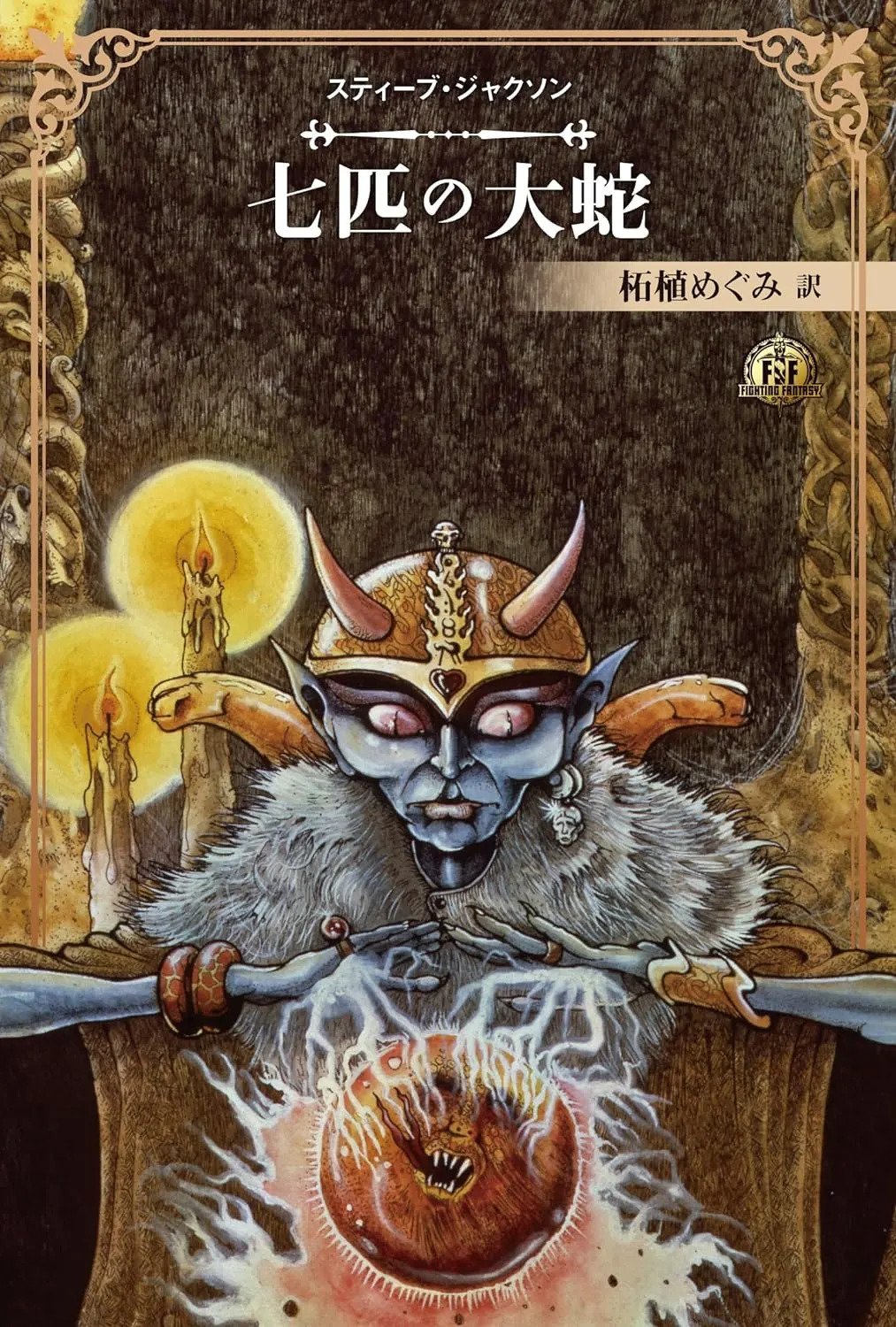
This April, Scholastic Books will release the final two parts of Steve Jackson's Sorcery! epic. And each one features brand new cover art by Rob Ball.


Which is next on your reading list?

Saturday, 7 August 2021

What's your ideal summer Fighting Fantasy read?

Now that summer has well and truly arrived upon your Earthly Plane*, bringing with it cold winds and rain, what is your go to Fighting Fantasy adventure for when you want to imagine yourself lying on a sandy beach under a blazing hot sun?

If Caribbean holidays are your thing, maybe it's Ian Livingstone's Island of the Lizard King?

Or, if you like things really hot, you might prefer to visit the Desert of Skulls via Ian Livingstone's Temple of Terror.


If you enjoy donning your backpack and hiking in the hills of some distant land, then the first book in Steve Jackson's Sorcery! series, The Shamutanti Hills, might be a favourite.


And if you like your holiday destinations even more exotic, you might want to visit the flying archipelago of Rhianna Pratchett's Crystal of Storms.

Of course, if you can't tolerate the heat, maybe you would prefer to head north to the Icefinger Mountains and the Caverns of the Snow Witch instead.


So what's you favourite summer FF read? Let us know in the comments below.


* For those of your in the northern hemisphere, at least. 

Friday, 11 June 2021

The Cartography of Kakhabad

Last week, we introduced you to the marvellous maps of FF fan Alnaro.

Well, it is not only the standard Fighting Fantasy series that he has mapped - he has also used his artistic talents to create a quartet of cartographic wonders for Steve Jackson's Sorcery! series. And here they are...


The Seven Serpents

The Crown of Kings


Wednesday, 1 April 2020

Tricksters and Riddlers

Today, upon your Earthly Plane, it is the day known as April Fool's, when people play all manner of pranks on their families and friends, hoping to catch them out by duping them into believing that their cunning fabrications are in fact the truth*.

Logaan, Lord of the Tricksters

There is also such a day here in Allansia, the Holy Day of Logaan, which falls on the 12th of Warming. Logaan is the Lord of the Trickster Gods, devoted to maintaining a balance between the forces of Good and Evil. He is often depicted as a crazed clown, accompanied by the mysterious twins Kata and Petros, who represent the pull between Order and Chaos.

Logaan is the creator of Mankind on Titan, and was the first god to put a part of himself into what he created from the magical clay of life. It was also Logaan who discovered the deity Time in one of the outer planes, which eventually led to the First Battle.

His priests are dedicated to their god's cause of balancing Good and Evil, Law and Chaos, and wear robes that are all the colours of the rainbow. This is representative of the fact that Logaan's interests cover the whole spectrum from Good to Evil.


Logaan is the chief deity of the town of Shazâar, in western Allansia, which is also known as the 'City of Madness'. Here they celebrate the festival known as Lucre Week in honour of their god. It also seems that some members of the Halls of Learning of Salamonis worship him.


Logaan is also the Lord of Genies, who are the immortal servants of the Trickster Gods. Apart from the many Humans who serve the Tricksters there are other races that are devoted to their creed. The Elvins of the Shamutanti Hills for instance are such a race.

Leprechauns also appear to follow Logaan's creed, although whether this is simply their nature or whether it is their belief is uncertain.

However, the most famous of the Trickster's servants is a powerful being called the Riddling Reaver. As to his origins, no one knows for certain, but he is said to live in the jungles of southern Allansia and sails around the world on his ship the Twice Shy, carrying out the work of his master Logaan.


The Riddling Reaver

A spin-off of Steve Jackson’s Fighting Fantasy – The Introductory Role-Playing Game, The Riddling Reaver (published in 1986) was an extended campaign made up of four interlinked multi-player adventures, written by Paul Mason and Steve Williams. The interior illustrations were by Brian Williams while the cover was by Peter Andrew Jones. The book also featured a number of maps by Leo Hartas.

Set in southern Allansia, a band of heroes find themselves in a battle of both wits and brawn pitted against the Riddling Reaver, an inscrutable servant of Logaan the Trickster, who is determined to upset the balance between Order and Chaos so that Chance and Luck might rule supreme.

The Riddling Reaver was Paul Mason’s first foray into the realms of Fighting Fantasy, but it certainly wasn’t his last. Both the Riddling Reaver and Lady Carolina, who appears in the adventure, and the city of Kallamehr itself would feature in Slaves of the Abyss, written by Mason and Williams, and published in 1988. The Reaver would later make another appearance in Mason's solo gamebook Magehunter.

The Riddling Reaver makes his escape in The Curse of Kallamehr.

The Riddling Reaver makes an appearance in Slaves of the Abyss.

The Riddling Reaver has some guests over for dinner in The Realm of Entropy. Recognise anyone?


* Personally I find a Befuddlement spell much more effective.

Friday, 14 February 2020

The Crown of Kings - 35 years of magic

2020 marks the 35th anniversary of the publication of The Crown of Kings, the fourth and concluding adventure of Steve Jackson's seminal Sorcery! series.

Jackson conceived the epic gamebook experiment after holidaying in Nepal, and several of the settlements that appear in The Shamutanti Hills, the first book in the quartet, are named after actual villages he came across on a five day trek he undertook from the city of Pokhara.

The Shamutanti Hills concludes with the hero - the Analander - battling the Manticore that has appeared on the cover of every edition of the book ever published. The second book in the series, Kharé – Cityport of Traps, charts the hero’s challenging journey through the titular city to the spell-locked Northern Gate, through which he has to pass to continue the quest for the Crown of Kings.

The Seven Serpents, the third book in the series, takes the hero across the inhospitable Baklands – a treacherous wilderness of deserts, forests, and swamps – and a vast lake, as the Analander attempts to hunt down and do away with the Archmage’s assassin-agents of the title, seven deadly and magical serpents. And in The Crown of Kings, the hero has to climb through the Xamen Peaks to the Mampang Fortress, and then battle his way through the Archmage’s lair.


The Crown of Kings was a whopping 800 references in length - a record yet to be broken by any other Fighting Fantasy gamebook) – was a suitably epic finale to Sorcery! series, and featured one of the most memorable (and clever) denouements of any adventure ever published, not to mention encounters with a god-headed Hydra and entire societies of birdmen and she-satyrs.

When Jackson talks about the Sorcery! series, he does so, understandably, with great fondness. When pressed on the subject of which of the gamebooks he has written are his favourites, he cites two: “Warlock because it was the first. And Sorcery! because it was the most complex. Creating a four-part adventure in which your actions in Book 2 might affect your choices in Book 4 was a real challenge. Also making sure they were all good adventures in their own right; you didn’t need to have completed Sorcery 1 to play Sorcery 2. I was very proud of Sorcery!

Of course, in more recent years, the Sorcery! series has been turned into a series of apps by inkle studios, as well as a multi-player role-playing campaign published by Arion Games, while the first two parts of the Analander's momentous quest are now in print again, courtesy of Scholastic Books.