Showing posts with label Alan Langford. Show all posts

Friday, 24 April 2026

40 years of Sword of the Samurai

40 years ago today, Sword of the Samurai was published for the first time.

Written by Mark Smith and Jamie Thomson*, the twentieth book in the series presented readers with the Fighting Fantasy version of Japan, in the form of the mystical land of Hachiman**.

The hero of the adventure is a young Samurai, Kensei, who is tasked with recovering the Dai-Katana - the Shogun’s great sword - which has been stolen by Ikiru, the Master of Shadows, who dwells deep in the Pit of Demons.

“At the time, the whole Samurai/Ninja thing was big and breaking out of the niche world it was in, into the bigger niche of gamebooks and RPGs, which had become substantially more popular than they had been for a long time,” says Thomson. “Still a niche, compared to cinema and even games like Monopoly and stuff, but a big niche.”

Sword of the Samurai was only the second time that Alan Langford had appeared on internal art duties at the time, while Peter Andrew Jones contributed his first cover since Talisman of Death***.

“I’ve been fascinated with the East ever since I read a book called The Earth is the Lord's by Taylor Caldwell,” says Langford. “It’s about the early life of Genghis Khan – Temujin – and that fired up my interest. The other source is Kubla Khan, and that was illustrated by Frank Frazetta. So Sword of the Samurai was quite an interesting job for me to do.”

Sword of the Samurai was translated into numerous languages, including Bulgarian, Czech, French, German, Hungarian, Italian, Portuguese****, and, appropriately enough, Japanese.

We already know that Fighting Fantasy is big in Japan, but it is even bigger now that YOU ARE THE HERO: An Interactive History of Fighting Fantasy Gamebooks has been published in Japanese.

* Who had previously worked together on Talisman of Death.

** Which Marc Gascogine would later make part of Khul.

*** The Wizard Books' edition featured cover art by Mel Grant.

**** Sword of the Samurai - or A Espada do Samurai - is still in print in Brazil.

Wednesday, 1 September 2021

Creature of Havoc comes to Fighting Fantasy Classics

The necromancer Zharradan Marr is close to stealing the secrets of Elven magic and none can stop him. YOU are the Creature of Havoc, a monstrous beast with a taste for fighting. Ruled only by hunger and rage, you have no knowledge of your past or destiny. Will you stop Marr or succumb to his evil?

Steve Jackson's seminal Fighting Fantasy gamebook Creature of Havoc has joined the other titles on the Fighting Fantasy Classics shelf on Steam, courtesy of Tin Man Games.

Featuring Alan Langford's original illustrations, this is a faithful adaptation of what, for many, is the ultimate gamebook.

An appointment with Zharradan Marr and his minions awaits you! Dare you face the mighty Darramouss or ride the Galleykeep, a flying ship of great renown?


“This book has what must be one of the densest and most satisfying plots of any FF, which, through constant changes of location, ongoing aims, and self-awareness, remains compelling and pretty intense throughout.” - Mathus Dire


Any die-hard Fighting Fantasy fan will tell you that this gamebook is brutal, but brilliant. Steve Jackson really found his stride with Creature of Havoc, the 24th book in the original Puffin paperback run. It is also one of the longest gamebooks in the series and includes a detailed background into the goings-on in Trolltooth Pass. Enjoy the pain, revel in becoming the beast, and seek out the truth! Grab it NOW!

If you're new to Fighting Fantasy Classics, now is a great time to try them out, with these two great bundle deals available now!


Friday, 25 June 2021

Blast from the Past! Spellbreaker

Spellbreaker
(FF53) was published 28 years ago this week, while its author, Jonathan Green, was still studying at university.

The story begins with the hero inadvertently enabling Nazek (another Warlock) to steal the Black Grimoire from its guardians at Rassin Abbey in the Old World kingdom of Ruddlestone. To make amends, the hero sets out to track down the villain in order to stop him from opening the legendary Casket of Shadows, and releasing the evil imprisoned within.

Art – both exterior and interior – was provided by Alan Langford. It was the first and last time the artist painted a cover for the series, despite having illustrated five FF adventures before Spellbreaker.

“They just asked me to do it,” says Langford, “which was rather nice, because you get paid rather more for cover art than you do for your inside work.” The image was produced using predominantly watercolours. “I used a little bit of permanent white gouache as well, which is my normal technique for watercolour.”

The Devilworm, which was inspired by the legend of the Lambton Worm.

One of the internal pen and ink illustrations provided by Alan Langford.

(© Alan Langford, 1993)

However, when Wizard Books republished the adventure in 2007, Martin McKenna was commissioned to produce a new piece of cover art, which was done digitally. (Green had been keen to have McKenna illustrate one of his FF adventures ever since being commissioned to write Spellbreaker, back in 1992.)


Despite being incredibly difficult to complete fairly, Spellbreaker still has its fans among the Fighting Fantasy community.

Did you know...?

It was John Sibbick’s image of a dragon attacking a band of adventurers, determined to steal its treasure hoard, that appeared on the front cover of Dungeoneer, that inspired Green to write Spellbreaker in the first place, because he thought the forward-facing dragon was actually a demon!


Friday, 13 November 2020

Blast from the Past! Creature of Havoc

Written by Steve Jackson, co-creator of Fighting Fantasy, and first published in 1986, Creature of Havoc has quite rightly gone on to achieve legendary status and remains a firm favourite with many FF fans today, despite the fact that it is so complex and challenging.

Utilizing a device that has been imitated in numerous gamebooks many times since (and not just Fighting Fantasy ones), the story begins with the hero waking up with no memory of where he is, how he came to be there, who he is or even what he is. The hero is the havoc-creating Creature of the title.

The book even goes so far as to initially give the beast no concept of language or reason. The hero attempts to make choices but is often thwarted in the early stages of the adventure, when the beast all too often resorts to acting on instinct alone. Slowly, however, the greater plot unfolds as the hero begins to discover what exactly has happened to him and who is responsible.

Featuring a flying ship, an undead Half-Elf and Zharradan Marr, an evil witch-born sorcerer, it is a truly memorable adventure with some wonderful set pieces. And no doubt many readers raised a snigger when they discovered that the Creature’s snack food of choice is Hobbits.

The Galleykeep, made by Steve Beale.

The book took Steve Jackson five months to write and contains the longest background section of any FF adventure (running to nineteen pages and containing information on everything from Elven birthing practices to the sorcerer Volgera Darkstorm).

Jackson: “With Sorcery! I’d written each adventure longer than the previous one. I didn’t have the same 400-reference limit which had kind of become a standard like the main FF series. Always looking for new angles, I’d decided that Creature of Havoc would set the reader as a monster. That was a new feature. And that I wouldn’t be bound by the 400-reference adventure. I was particularly pleased with the reader having to learn a language."

But how was Jackson able to include Hobbits in the book? “I can remember there being some debate at the time as to whether Hobbits were copyrighted or not. Someone somewhere came up with a reference to Hobbits in medieval literature.”

The book featured a cover by Ian Miller. The green-skinned figure that is the focus of the image was originally supposed to be Darramouss the undead Half-Elf. However, when Jackson saw the finished painting, he was so impressed he went back and changed the text so that the figure on the front became the Creature’s vile nemesis, the black-hearted, half-demon sorcerer Zharradan Marr.

Zharradan Marr, by Alan Langford.

“In truth I did not know this,” Miller told Alex Ballingall, when he was interviewed for the FF fanzine Fighting Fantazine, “but it’s nice to think the image resonated so. Maybe that comes of reading the book and meeting the author.”

Alan Langford produced the internal illustrations for the book, including such fondly-remembered monsters as the Clawbeast, the Toadmen, and the disturbing undead Master of Hellfire.

“I enjoyed doing that one,” says Langford. “I didn’t like the murder of Hobbits though; I’m quite fond of them.”

Master of Hellfire, by Alan Langford.

So which is the artist’s favourite image from the book?

“I think it’s one with the shadow of the monster in the foreground and a Dwarf cowering in the background. That one stays in my mind in particular, not because it was my favourite, because it… sort of turned the situation around in a visual way. You got that experience all the way through the written part that Steve did, but my illustration… that was the one that sort of brought it together. The rest could have been just an ordinary Fighting Fantasy book, but that’s the one that stays in my mind.”


Cowering Dwarf, by Alan Langford.

Creature of Havoc was the last FF title to bear the green zigzag banner across the top of its cover and is also the last Fighting Fantasy gamebook Jackson has written to date.

The book remains a fan-favourite to this day. “It was full of great details and ingenious puzzles,” says Jon Ingold of Inkle Studios, the people behind the app versions of Jackson’s Sorcery! series, “and really pushed the boundaries of how these books could work.”

Creature of Havoc is back for a new generation in a a new edition, available now from Scholastic UK.


The French edition of the adventure is also available in a new edition, from Gallimard.

Wednesday, 1 July 2020

La Créature Venue du Chaos

The latest Fighting Fantasy gamebook to be reissued by Gallimard Jeunesse in French is Steve Jackson's Creature of Havoc, or La Créature Venue du Chaos.

Is this the first time the 'hero' has appeared on the cover of a Fighting Fantasy gamebook?

The cover art is by Paul Mafayon, a French artist who also provided the wraparound covers for the newest French editions of Ian Livingstone's Deathtrap Dungeon and Caverns of the Snow Witch.


This new large format edition of La Créature Venue du Chaos includes Alan Langford's original illustrations, as well as the addition of a bonus Archives of Allansia section - focusing on places, characters and monsters connected to the adventure - and a set of pre-generated characters.

If you would like to add the Gallimard Jeunesse editions to your Fighting Fantasy collection, you can purchase them here.


Monday, 22 April 2019

Fighting Fantasy Easter Eggs - The Answers!

On Friday we asked you, in which Fighting Fantasy books do these eggs appear? Well here are the answers...

A) 
City of Thieves, by Ian Livingstone
- from Iain McCaig's illustration of the Market Square, where an old crone is offering you a couple of eggs to throw at the poor wretch locked in the stocks.

B) 
Island of the Lizard King, by Ian Livingstone
- from Alan Langford's illustration of the Razorjaw nest.

C) 
Titan - The Fighting Fantasy World, by Marc Gascoigne
- from Alan Langford's illustration of a Lizard King hatching.

D) 
City of Thieves, by Ian Livingstone, again
- from Iain McCaig's illustration of the panicking Silversmith.

How did you fare? If you got all the answers right, why not let us know in the comments below?

And if you like quizzing, don't forget, the second dedicated Fighting Fantasy Pub Quiz is being held the evening before Fighting Fantasy Fest 3, where Alan Langford will be one of the guest artists in attendance.

Saturday, 13 April 2019

Blast from the Past! Portal of Evil

Thirty years ago, Puffin Books published the 37th book in the Fighting Fantasy series - although the book didn't have the number 37 appear anywhere on its cover - and the second title to be written by Peter Darvill-Evans.

Set in the area surrounding the city of Neuberg in Khul, Portal of Evil was an adventure involving magical portals and a dinosaur invasion of Titan. “I wanted to write something different,” says Darvill-Evans, “so a portal to another world of dinosaurs seemed appropriate. And everyone likes dinosaurs.”

The book featured a cover by Games Workshop artist David Gallagher cover, who had also painted the cover for Marc Gascoigne's Battleblade Warrior. “Battleblade was the first cover I did for Puffin,” says Gallagher. “I was freelancing and this was Puffin’s response to my initial approach for work.”

Portal of Evil featured illustrations by Alan Langford, back on dino duties following Battleblade Warrior and Ian Livingstone's Island of the Lizard King. “ZdenÄ›k Burian, Ray Harryhausen and Frank Frazetta – they were my influences as far as dinosaur art went,” says Langford.

Both Peter Darvill-Evans and Alan Langford will be attending Fighting Fantasy Fest 3 in August, and talking about their collaborations. So if you have a burning question you would like to ask either of them, make sure you book your place at the Convention of Firetop Mountain today!


Friday, 14 July 2017

The Second Swordsman – 'We’re not on Titan anymore (Toto)'

This week it's time for the sixth in Malcolm Garcia's Second Swordsman series. Enjoy!


The Second Swordsman – 'We’re not on Titan anymore (Toto)'

By Malcolm Garcia

After coming so very close to succeeding in my first FIGHTING FANTASY adventure by arbitrarily choosing every second option (in Battleblade Warrior) I decided to attempt a trio of adventures which, while starting on the familiar world of Titan, soon cast the adventurer far away into places hitherto unknown.

In Spectral Stalkers, Portal of Evil and Phantoms of Fear YOU start as an adventurer on the continent of Khul. I’d previously only visited Khul when attempting Seas of Blood and was looking forward to exploring more of the land-based perils. Spectral and Portal start off in the south-west of the continent, near the town of Neuburg and were both written by Peter Darvill-Evans (his other addition to the FIGHTING FANTASY range being Beneath Nightmare Castle, which is actually set in Neuburg). Phantoms is set in north-east Khul and was written by Robin Waterfield, who also penned Masks of Mayhem and Deathmoor (which I’ll attempt if I can ever get my hands on a copy without having to sell a kidney).

In Spectral I started off with impressive SKILL and LUCK scores, but my STAMINA was not so great and I had only two meals and a small amount of gold. But none of this would be of any consequence as choosing every second option proved to be a particularly foolish process to use in this adventure. At the very start YOU are whisked away from Khul after coming into possession of a magical artifact that is being sought by the eponymous Spectral Stalkers. But from the very beginning of Spectral I had no idea about what I should be doing or where I should be going. While this was initially intriguing, it soon gave way to a feeling of helplessness.

I bumbled through the Library of Limbo (ignoring advice from a dragon librarian) and, despite several opportunities to do otherwise, failed to learn anything useful about the world I was in or my quest. I managed to ignore so many things in Spectral that I didn’t even have a single battle in the whole adventure. (The only other time this happened was in Island of the Lizard King – where I died within four choices of the start). I also never once got to Test my Luck. I got the feeling in Spectral that I made a poor choice near the start which would have otherwise led to me gathering some important knowledge and objects. What killed me in the end was suitably anticlimactic – it wasn’t a horrible trap or a fiendish beast, but a moat of acid. Even Deathtrap Dungeon provided some imaginative expanding fungus to finish me off.

Giving southwestern Khul (and Peter Darvill-Evans) the benefit of the doubt, I returned there to explore the mystery of the Portal of Evil. This adventure is set in the wilderness between the cities of Zagoula and Neuburg, but the eponymous portal promised to whisk me far away from all of this, if I could survive long enough to find it. Which I didn’t. It all started so very well, with decent SKILL and STAMINA scores (and a joke in the introduction about lawyers being akin to thieves). But then I adopted a passive approach that is all-too-familiar when choosing every second option. While I did get to fight my first ever FIGHTING FANTASY dinosaur, the battle was over before I could kill it, I also failed to help a talking dinosaur, didn’t search a body of a foe I’d killed, and even ignored a shiny thing hidden in a tree. Surely everybody knows that on Titan adventures can succeed based solely on the possession of shiny things!

I also, in a manner similar to Spectral, had the feeling that I made a poor choice early in Portal. There were several times at relatively early stages of my quest where I was asked if I had certain specific objects I’d yet to come across – a ring of zombie warding, a warrant from the Margrave, and even some gold coins. This happened often enough to make me believe I had missed out on an important chunk of the adventure by following the Second Swordsman process. In another disappointment, my failure in Portal was brought about by being captured by a group of soldiers. While this isn’t my biggest failure, I’d put it on par with my fate in Trial of Champions.

And so then I travelled far, to the north-east of Khul and the Affen Forest to become a Forest Elf and learn from a dream that I needed to defeat a Demon Prince. In Phantoms dreams are an important part of the adventure; you learn things through them, and at later stages of your quest you can alternate between the real world and the dream world. The illustrations by Ian Miller (who did the covers for several FIGHTING FANTASY novels but only did the internals once) enrich the nightmarish atmosphere of the adventure which, for the most part, gave me a sense of being worn down by despair.

My initial SKILL, STAMINA, and LUCK scores were reasonable (but not great), and Phantoms added a POWER score which gave the ability to cast spells. Unlike Spectral, from the beginning of my adventure I knew where I needed to go, and I fought plenty of creatures along the way – sixteen in total. Several of these battles were made more difficult by imposed losses of SKILL (I’m looking at you Fog Devil and everything I faced after breathing in the evil mist). I also had several battles where there were a few too many unlucky rolls of the dice (against the Wolves – who almost killed me – and a Komodo Lizard). But I was saved from an early defeat in Phantoms by my own food scavenging skills, and choosing the potion of strength at the start of the adventure. What didn’t help me was anyone at all. There were no friendly witches, merchants or fellow adventurers to give me any advice or special objects; I was on my own from the very beginning.

After making my way through the depressing part of the forest, that had been blighted by the evil of the Demon Prince, I finally entered their underground lair and gained the ability to control my shifting between the real and dream worlds. Rather than do this at every opportunity I made the decision to do it every second time it was offered. The two worlds are parallel to each other – a path you take in one will move you forward in the other. But soon after my first attempt at changing into the dream world, my real world body was attacked and I had to change again to complete the fight. Then, on my second opportunity to enter the dream world, I had to fight a mirror image of myself, a fight that somewhat arbitrarily took the shape of a series of random dice rolls, of which I lost way too many and was killed.


All in all these three adventures were a rather unsuccessful attempt to find success away from the familiar world of Titan. I never reached the portal in Portal, I entered the dream world only fleetingly in Phantoms and, while I went far away in Spectral, I never knew what I was trying to do when I got there. But I was intrigued by the world I visited in Spectral, and the depressing atmosphere of Phantoms meant I’d visit both of these FIGHTING FANTASY adventures again one day.


Thank you, once agin, to Malcolm, for another Second Swordsman blog post. If you have any suggestions for items for the official Fighting Fantasy blog don't forget to get in touch via mail@fightingfantasy.com.

Friday, 16 June 2017

The Second Swordsman – 'The Scales of Adventure'

This week it's time for the sixth in Malcolm Garcia's Second Swordsman series. Enjoy!


The Second Swordsman – 'The Scales of Adventure'

By Malcolm Garcia

While all manner of creatures roam the continents of Titan, there are very few species that have become organised enough to form societies and take control of the land around them. Humans have their cities, such as Port Blacksand and Kharé, and the dwarves have Fangthane and Stonebridge. But there are also the Lizard Men, who have their own extensive Empire in south-western Allansia and are your principal adversaries in two FIGHTING FANTASY adventures – Island of the Lizard King and Battleblade Warrior.
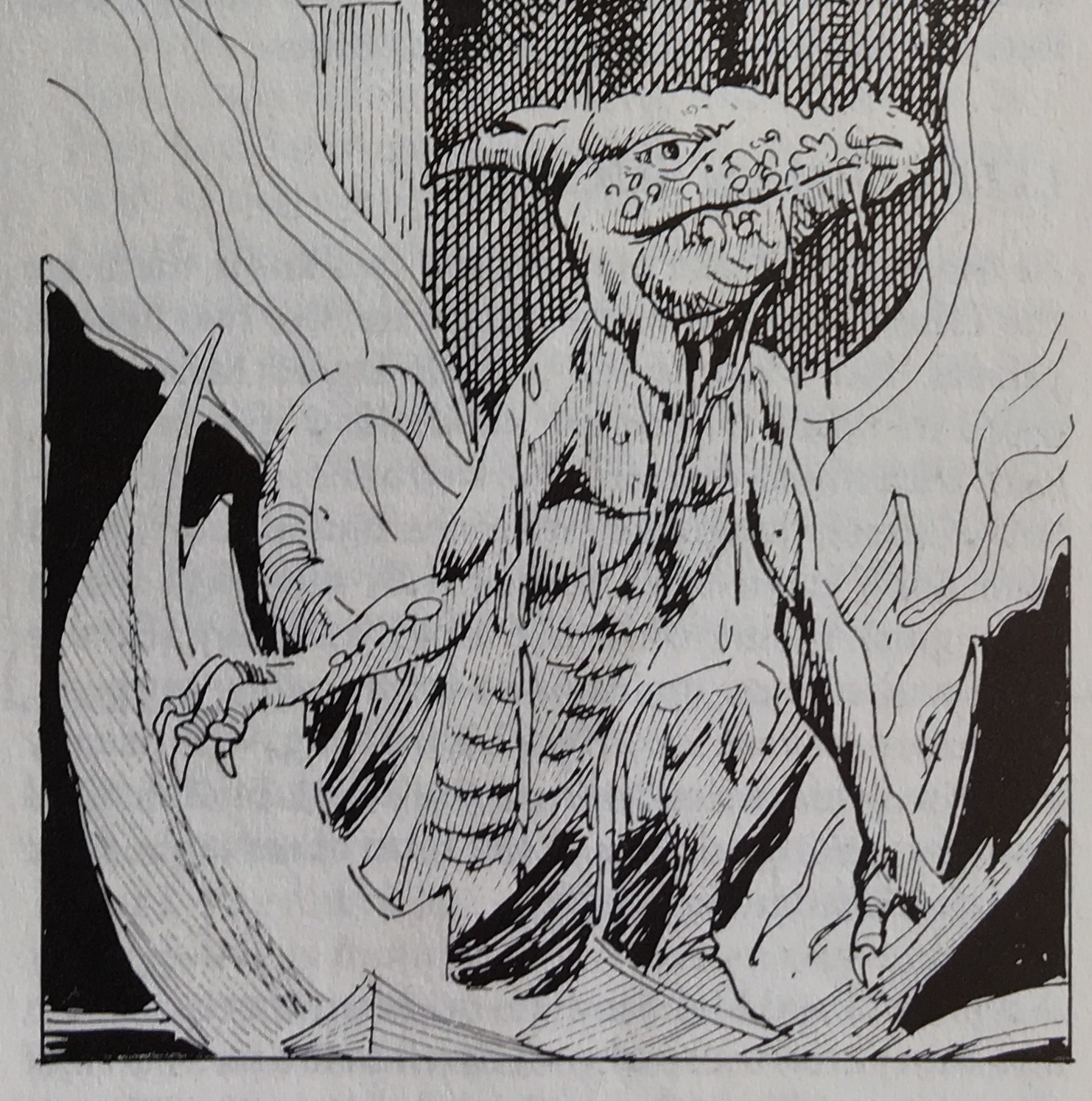
Island was the fifth book to be penned by Ian Livingstone (making this the seventh of his adventures I’ve attempted using the Second Swordsman process) while Battleblade was the only time that Marc Gascoigne wrote a FIGHTING FANTASY book, despite being deeply involved in the series. Both Island and Battleblade were illustrated within by Alan Langford, the go-to guy for dinosaurs, and he would later return to provide more thunder lizards for Portal of Evil (which I’ll visit soon).

The Second Swordsman process performed surprisingly in both of these adventures. The bad surprise was in Island where I set a new record for defeat. The mission was fairly straightforward, kill the eponymous Lizard King and free the prisoners that he and his Lizard Men army are keeping captive on Fire Island. My initial rolls gave me decent SKILL and LUCK scores and, while my STAMINA was lower than I’d like, the background to the adventure provided plenty of provisions to replenish my STAMINA between battles. I arrived on the island with my buddy, Mungo, who told me of his father’s death in Baron Sukhumvit’s Deathtrap Dungeon (an adventure where a previous incarnation of me perished way too soon because of some dodgy fungus). There is some speculation that the hero of Island is the same hero from Deathtrap but, as my character mentioned nothing of the labyrinth during our boat ride, I figure this to be unlikely.

My defeat on Fire Island was brisk. I initially found some pirates huddled around a treasure chest. They no doubt thought that somewhere with Fire Island’s reputation would be a safe place to stash their booty. I decided to ignore them (a frequent action when using the Second Swordsman process) and explore somewhere else, whereupon Mungo was seized by a giant crab. Rather than come to his aid with my sword, I cowardly ran away… into quicksand… where I instantly died. While my previous deaths in both Deathtrap and Trial of Champions (which were also authored by Livingstone) were relatively early, my adventure on Island set a new record – dead in four choices.

Chastened and reincarnated, I headed south to Vymorna where my mission was to head into the mountains of the Lion Heights and find a magical weapon that would help to lift the siege imposed by the Lizard Man Empire upon my city. While my initial SKILL and STAMINA were good, my LUCK score was not ideal. Battleblade also limited the number of provisions to four and removed the usual ability to choose a helpful potion. However the Second Swordsman process was up for the challenge.

During my adventure I fought the most creatures I have so far – twenty-two in total, seven of which were Lizard Men (which is a welcome change from Island where I killed nothing). The monsters were nicely balanced with only a few being fairly difficult – the Swamp Mutant and the Warrior King – and in several of the battles I lost no rounds of combat at all. At one point I was lucky enough to grab a Lizard Man by his foot and have him fall onto his own sword, and I also had the most melees I’ve yet encountered in a FIGHTING FANTASY adventure.

Unlike several other adventures, in Battleblade choosing every second option did not make me ignore opportunities for action. I struck down the crew of a catapult which was throwing projectiles at Vymorna and also attacked several Rat Men engineers who were part of the siege. After escaping the siege I crossed plains and jungle to reach the city of Kharnek, hidden in the mountains and the place where the Blade of Telak, the magical weapon I was searching for, was said to lie. Something that Battleblade does quite well is to give a sense of scale (pun not intended). The journey from Vymorna to Kharnek took several days and there were several occasions when I wondered if I was on the right path at all.


While I lost plenty of STAMINA during my battles in Battleblade, my four provisions (and several opportunities to replenish these) kept my STAMINA from failing me. My longevity did, however, have a cost upon my LUCK which was constantly eroded away. Fortunately Battleblade replaces some obvious LUCK tests with SKILL trials (which I passed easily) and even when I was unlucky, I wasn’t doomed to an instant death and sometimes had the opportunity to fight my way out of the situation.

Once I reached Kharnek I found half of the Blade of Telak and, for a brief moment, thought this would be the first adventure where the Second Swordsman process worked. Until it didn’t and I suffered an instant death. Backtracking for the first time, I found where I went wrong and how I could have won. Thus, if not for one choice where I bizarrely decided not to pick up an item within a few sections of the end, I would have succeeded. In other FIGHTING FANTASY adventures (such as The Citadel of Chaos, The Forest of Doom and Starship Traveller) I have come tantalisingly close to the geographic end of the adventure, but without having either knowledge or special objects necessary to succeed. In Battleblade this was not the case. For most of the adventure all that is necessary is to survive – missing something near the start will not doom the reader to failure and some clever or lucky choices near the end will be rewarded with victory.

I’ll revisit both Island and Battleblade in the near future, but without the Second Swordsman process. I can’t possibly do any worse in the former and I think I’ve got a good chance of succeeding in the latter.


Thank you, as always, to Malcolm, for his latest Second Swordsman blog post. If you have any suggestions for items for the official Fighting Fantasy blog don't forget to get in touch via mail@fightingfantasy.com.