Showing posts with label The Old World. Show all posts

Sunday, 26 May 2024

Une Entreprise Épique

Belgian Fighting Fantasy fan Gil Jugnot has mapped the Fighting Fantasy (or Défis Fantastiques) gamebooks, including the Sorcery! quartet and The Tasks of Tantalon, onto the maps of the three continents of Titan published by Scriptarium. And here they are.

Allansia

The Old World

Khul


Sunday, 31 October 2021

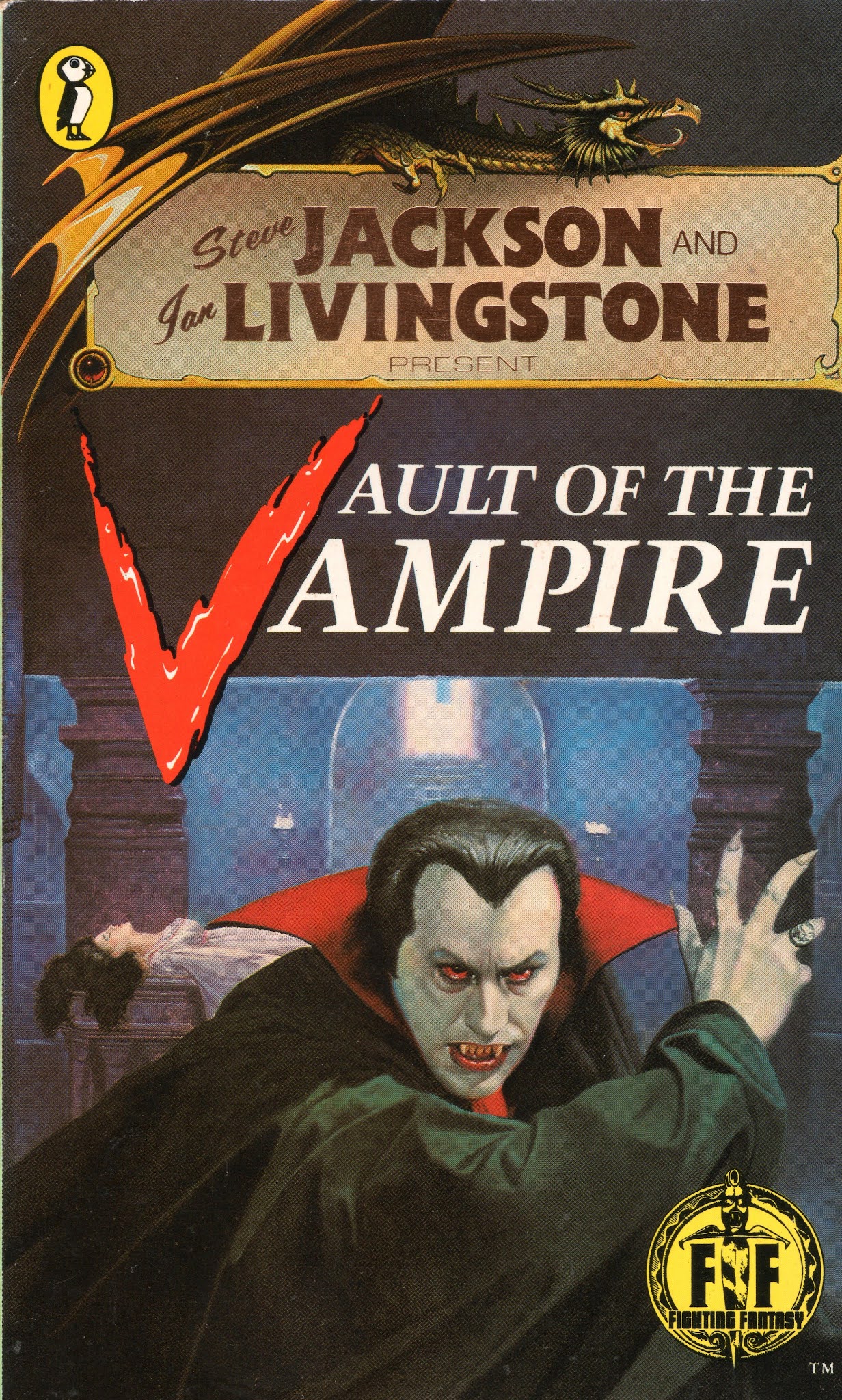
Blast from the Past! Vault of the Vampire

Published in 1989, Vault of the Vampire was the 38th gamebook in the Fighting Fantasy series. Written by the late Carl Sargent, under the name Keith Martin, and illustrated by the late Martin McKenna, FF's riff on Dracula is a bona fide classic of interactive horror fiction.

Interestingly, despite blood-suckers appearing on a regular basis throughout the previous thirty-seven titles, up until this point no one prince of the night had taken centre stage and become the Big Bad to be dealt with at the climax of an adventure.

Keith Martin rectified this by transporting the reader to Titan's version of Transylvania, set within the mountainous Old World realm of Mauristatia, replete with wolves howling at the moon, creepy forests, a headless coachman, and a sinister, bat-haunted castle.

The plot is also just what you would want from a story called Vault of the Vampire...


Can you put an end to Count Heydrich's evil reign of terror?

YOU are a hardy adventurer and have journeyed to the icy mountains of Mauristatia in search of great wealth and fortune... but what you find there makes your blood run cold.

You discover by chance the terrible secret of the local villagers. Can YOU free them from the evil tyranny of the bloodthirsty Count, or will you too succumb to a horrifying fate?

Two dice, a pencil and an eraser are all you need. YOU decide which paths to take, which dangers to risk and which foes to fight!


Les Edwards painted the cover for the book: “Vault of the Vampire turned out to be one of those classic images. I can’t say why exactly. It’s just one of those cases where everything works the way that was intended. It’s a pretty traditional Vampire but maybe that’s part of its strength. It’s a simple and dramatic image and very direct. It was a big influence on Vampire paintings that I did subsequently.”

Martin McKenna, who was still only eighteen at the time, turned his hand to producing some very Hammer Horror-esque images for the book’s internal illustrations that have stood up to the test of time very well.


A blood-soaked sequel followed in 1995, entitled Revenge of the Vampire. This was the only occasion a direct sequel to a gamebook was written by an author other than the series’ co-creators Jackson and Livingstone.

Revenge of the Vampire (FF58) was Keith Martin’s seventh contribution to the Fighting Fantasy gamebook series. In the story, Count Reiner Heydrich returns from the dead once more to stalk the Old World in search of fresh blood and new slaves. It is up to the hero (who is not the same hero as featured in Vault of the Vampire) to put an end to him once and for all.


Count Heydrich, Vampire, is back from the dead!

A half-forgotten evil has arisen from the grave to stalk the Old World in search of fresh blood and new victims to enslave. Count Reiner Heydrich, undead Vampire Lord, is ancient beyond the reckoning of mortals. This time, however, there is someone on his trail, a brave hero who is determined that he shall not succeed in his evil plans. That someone is YOU!


As well as being written by Keith Martin, author of Vault of the Vampire, once again Les Edwards painted the stunning cover image while Martin McKenna came up trumps with the internals.


Friday, 25 June 2021

Blast from the Past! Spellbreaker

Spellbreaker
(FF53) was published 28 years ago this week, while its author, Jonathan Green, was still studying at university.

The story begins with the hero inadvertently enabling Nazek (another Warlock) to steal the Black Grimoire from its guardians at Rassin Abbey in the Old World kingdom of Ruddlestone. To make amends, the hero sets out to track down the villain in order to stop him from opening the legendary Casket of Shadows, and releasing the evil imprisoned within.

Art – both exterior and interior – was provided by Alan Langford. It was the first and last time the artist painted a cover for the series, despite having illustrated five FF adventures before Spellbreaker.

“They just asked me to do it,” says Langford, “which was rather nice, because you get paid rather more for cover art than you do for your inside work.” The image was produced using predominantly watercolours. “I used a little bit of permanent white gouache as well, which is my normal technique for watercolour.”

The Devilworm, which was inspired by the legend of the Lambton Worm.

One of the internal pen and ink illustrations provided by Alan Langford.

(© Alan Langford, 1993)

However, when Wizard Books republished the adventure in 2007, Martin McKenna was commissioned to produce a new piece of cover art, which was done digitally. (Green had been keen to have McKenna illustrate one of his FF adventures ever since being commissioned to write Spellbreaker, back in 1992.)


Despite being incredibly difficult to complete fairly, Spellbreaker still has its fans among the Fighting Fantasy community.

Did you know...?

It was John Sibbick’s image of a dragon attacking a band of adventurers, determined to steal its treasure hoard, that appeared on the front cover of Dungeoneer, that inspired Green to write Spellbreaker in the first place, because he thought the forward-facing dragon was actually a demon!


Friday, 30 October 2020

Blast from the Past! Dead of Night

Today being the eve of All Hallows' Eve, it seemed like an appropriate time to revisit this chilling classic of yesteryear - Dead of Night!

First published on 2 November 1989, Dead of Night (copyright Jim Bambra and Stephen Hand) took as its setting the kingdom of Gallantaria. the adventure taking place after the events related in The Tasks of Tantalon. It helped complete the integration of the Old World into the wider Fighting Fantasy milieu, being the first solo gamebook to be set there since The Crown of Kings concluded Steve Jackson's Sorcery! series back in 1985.

Working together – rather like Jackson and Livingstone had in the beginning – Bambra tackled the task with his standard approach to writing fantasy scenarios, whereas Hand was keen to push the limits of what was possible in a gamebook. Hand was also hugely inspired by pulp horror, such as the kind produced by Hammer studios in the 1960s and ‘70s.

They agreed that their version of the Old World would be a grimly realistic place, a slice of a horrific medieval world in which politics would play its part too (as can be seen more clearly in Hand’s later, solo titles).

In Dead of Night, the hero is a Demon-Stalker, who has dedicated his life to waging war against the creatures of Chaos. Having thwarted the evil schemes of the Demon Prince Myurr on more than one occasion, the hero’s nemesis exacts his revenge, striking directly against the Demon-Stalker’s family. On top of that, Myurr’s powers are growing and he will soon be able to transport his demonic hordes to the Earthly Plane. The Demon Lord must be stopped!

"On that first book, what happened was that Jim and I plotted all the scenes and characters together," Stephen Hand explained in an interview with AdvancedFightingFantasy.com. "Then we divided the different scenes between us, so I would write one area, and he would write another. When we finished, we actually swapped documents and edited each other's work. This may sound strange, but it worked and lead to a fairly even book written by two very different writers."

In addition to the regular attributes of SKILL, STAMINA and LUCK, Dead of Night features an EVIL score, which start starts at zero. Throughout the adventure, the player may encounter people or creatures, or do things that will increase this score. As a result the player is asked to Test Your Evil at certain points in a manner similar to Testing Your Luck.

The player also has a choice of three "Talents" for their Demon-Stalker, which include Banish Undead, Dark Veil, Heal, Holy Circle, Meditation, Sense Demon, and Speak Demon.

The gamebook was illustrated by Martin McKenna, with a cover by Terry Oakes.

The Abomination, by Martin McKenna.

Dead of Night remains both the first and last time that Bambra contributed an adventure to the FF series, but what a memorable entry it was! Hand, on the other hand, would go on to contribute two more Gallantaria-set adventures before quitting the series - the equally impressive Legend of the Shadow Warriors and Moonrunner.

Saturday, 17 February 2018

The Second Swordsman - In Safe Hands?

It is one year to the day since Malcolm Garcia posted his first The Second Swordsman piece. Since then write-ups of another twelve attempts have been posted, featuring 35 different Fighting Fantasy adventures!

Today, to mark the first anniversary of The Second Swordsman, Malcolm presents his 14th post, which is intriguingly entitled...


The Second Swordsman - In Safe Hands?

By Malcolm Garcia


While several of the FIGHTING FANTASY adventures I have recently attempted have had an oppressive atmosphere, namely House of Hell, Phantoms of Fear and Spellbreaker, few authors create an unremitting sense of despair as well as Stephen Hand. All of his three books are based in the northwestern part of the Old World, a continent I hadn’t visited since an earlier attempt at using the Second Swordsman process on a trio of adventures by Jonathan Green. And in each of Hand’s books a feeling of dread pervades the somewhat-medieval world that YOU move through in your quests.


In Legend of the Shadow Warriors YOU are an army veteran who, somewhat skeptically, accepts the task of investigating claims of shadowy riders terrorizing the village of Karnstein, deep in the mountains of the Witchtooth Line. In Moonrunner YOU are a bounty hunter who is hunting (or should that be, is being hunted by) the evil war criminal Karam Gruul through the city of Blackhaven, a place that somehow makes Port Blacksand seem like a nice spot to retire to. And in Dead of Night (co-authored with Jim Bambra) YOU are a Demon-Stalker who is being plotted against by your old adversary, the Demon Lord Myurr, who is out for revenge after YOU have foiled too many of his horrid schemes. [These three titles were also all illustrated by Martin McKenna - Ed.]

While sticking with choosing every second option didn’t have me ignoring huge amounts of things in these books (as it has previously done so), it did mean I did some pretty stupid stuff, sometimes with significant consequences.

In Legend of the Shadow Warriors I started off promisingly enough when using the Second Swordsman process. Although I had a purse of gold I chose not to try and supplement it through gambling – while this worked in Legend of Zagor it failed to gain me any money in both Seas of Blood and Bloodbones. At the markets in Royal Lendle I bought every second item, including metal rot, a chameleon cloak, and a mirror (which would have been handy against the Mountain Basilisk in my previous adventure in Night Dragon). Although what I could get was limited by my budget, I generally enjoyed this process more than looking for individual objects in cupboards and under rocks. My first major NPC encounter was with Gallantaria’s chief tax collector, who I unsuccessfully tried to bribe and who then put me in jail for the, surely near-irrelevant in Titan, crime of unpaid taxes.

Luckily my quest did not end there (unlike when I was imprisoned in both Bloodbones and Black Vein Prophecy) and I managed to escape after fighting the jailer (although I was somewhat blasé about the fact that I’d added murder to my previous charge of tax evasion). As I made to leave through one of the city gates I was again confronted by the tax collector. With a poor starting LUCK score I was unlucky and put in a better-guarded jail. My adventure thus ended without even leaving Royal Lendle.

I started Moonrunner with similar SKILL, STAMINA and LUCK scores to those in Legend. As an experienced bounty hunter YOU are able to choose several special skills at the beginning – I selected every second one, of course. The book started ominously with the man I had been talking to in the background section being killed by a throwing dagger. Thanks to my recently acquired lock picking skill I obtained some gold pieces and potentially useful paperwork from his office. My searching of the room was interrupted by some guards, but I was able to use another of my skills to confuse them and escape – thus avoiding having another adventure end in my imprisonment.

As my exploration of Blackhaven got under way, by choosing every second option I then callously decided not to give a beggar a single gold piece (even though I could easily afford to) and then not to pursue her killer, the fantastically named ‘The Shocker’. Instead I headed for the local asylum and, after turning down an offer of a drink from the deputy director (being keen to avoid what happened when I did that in House of Hell) I gained some information about Gruul from one of the inmates. But then I got locked up, again! I escaped only after fighting a Frankenstein-esque creature and headed for another potentially useful source of information, but he turned out to be dead too. In my search of his room I gained some more gold and paperwork, but this time the letter was from Gruul himself, and it had been laced with mocking words and a poison which killed me instantly.

As with Moonrunner, at the start of Dead of Night YOU can choose three skills that YOU have learned during your life as a Demon-Stalker. As the Second Swordsman I chose every second one and also picked up some gold, holy water and an ominous vision of my parents and Myurr. Because YOU are an adventurer who can stray close to the dark side, there is also a personal EVIL score for YOU to keep track of.

I began by arriving in my home village of Crowford after ignoring a mocking skeleton and went to visit the local priest. He told me my parents were dead, but that their graves have been taken over by demons. Although I could sense the demonic presence I chose not to confront the blight and thus earned my first EVIL point for being generally unhelpful. My next destination was that of a seer who conducted a summoning to help me in my quest; but the demon that was summoned killed her and I had my first fight on my hands.

After slaying the demon I left the seer’s cottage, which was now in flames, and chose to also ignore a group of peasants and an opportunity to pray. When I arrived in the next village I chose not to use one of my skills and narrowly escaped a swinging blade trap. Luckily I was rescued by the locals who told me of the onslaught their village was under from a swarm of Moon Demons. Rather than staying and helping the villagers – as any proper Demon-Stalker would – choosing the second option had me again being unhelpful and I abandoned them to their fate and walked outside, only to slip in the mud and be torn to shreds by the swarm.

Compared to other FIGHTING FANTASY books, while this trio by Hand had plenty of atmosphere, there was not much actual fighting. In my short-lived adventure in Legend I managed to only have one fight and, although I was unarmed (having been relieved of my sword when taken into custody), I defeated the SKILL 8 STAMINA 7 Jailer without losing a single round. I also had only one fight in Moonrunner, but this was a tough one against the SKILL 11 STAMINA 14 Kauderwelsch Monster. I was down to seven STAMINA when this battle was mercifully brought to an early conclusion by a riot of asylum inmates. For consistency I also only had one fight in Dead, against the summoned SKILL 8 STAMINA 8 Spirit Demon, which I killed after losing two rounds of combat, but which robbed me of a potentially useful ally.

In the end it was stupid decisions that brought about my failure in using the Second Swordsman process in Legend, Moonrunner, and Dead. A puddle of mud, a piece of paper, and not paying my taxes proved too much for a seasoned adventurer like me to overcome.  If there were any FIGHTING FANTASY adventures where I could have used a ‘Hand’ to save the Old World from unspeakable evil, these three books would have been them.


Congratulations to Malcolm on a year's worth of Second Swordsman posts. But there are plenty more Fighting Fantasy adventures still to go, so which will he be tackling next month?

Friday, 8 September 2017

The Second Swordsman – It’s Not Easy Being (the hero in a book written by Jonathan) Green

With Fighting Fantasy Fest over for another year (or two) it's back to business as normal here at www.fightingfantasy.com, which means it's time for another in Malcolm Garcia's Second Swordsman series. Enjoy!


The Second Swordsman – It’s Not Easy Being (the hero in a book written by Jonathan) Green

By Malcolm Garcia

After my previous trio of adventures, which were set in the all-too-familiar territory of Allansia, I crossed the ocean to see how the Second Swordsman process would fare in the Old World, the continent where the Sorcery! series is set and a land where I’ve so far feared to tread. And who better to be my guide than Jonathan Green who, although he penned his first FIGHTING FANTASY adventure in 1993, is still the most recent author to contribute to the world of Titan.


In Spellbreaker, YOU are trying to stop a horrible evil from being unleashed. In Stormslayer, YOU are trying to stop a jealous sorcerer from destroying the world with a horrible machine. And in Bloodbones, YOU are seeking vengeance upon the pirate who murdered your family and who might not be as dead as people believe.

So did the Second Swordsman process get me to 400 in any of these?

No.

In no particular order, I died during a battle against a much stronger enemy, died suddenly at the hands of a supernatural evil, and didn’t-quite-die but failed due to my stupidity. But despite these botched attempts, I did have some good adventures along the way.

Overall, in Green’s books, I got the sense that I was actually exploring the countryside during my quest, and not just slogging my way through a dungeon searching for magic objects while fighting every single creature I encountered. That’s not to say there wasn’t any fighting – in all three of these I had to fight something within the first couple of sections; some of which were quite strong for early stage enemies. But there are also whole towns and landscapes to explore with people I cannot attack who might either help me on my quest, or lead me to my doom.

Of these three books, my shortest-lived adventure as the Second Swordsman was in Bloodbones. My starting SKILL, STAMINA, and LUCK scores were good, I had a purse full of gold, and I was intrigued how the addition of a time factor would play out. I had an early fight with some pirates who might have been part of the possibly-undead Captain Cinnabar’s crew and then headed for the gambling halls of the Port of Crabs – which is possibly an even more perilous port than The Port of Peril. But then the process of choosing every second option made me ignore the games of chance on offer and I left with no more gold pieces than when I had arrived.

I continued to explore most of the city in my quest for clues and equipment. This resulted in me buying some weapons which held the promise of making future fights somewhat easier, but it also added much time to my tally. And when I decided to go and warn the Governor of the Port of Crabs about the risen Cinnabar, I foolishly chose not to bribe several people and ended my adventure prematurely, locked in a cell.

Spellbreaker was Green’s first FIGHTING FANTASY book and with its opening scene of monks and a fight against a demon it created an interesting Middle Ages atmosphere for the north-eastern part of the Old World in which it was set. The adventure sets me up with a deadline of four days in which I am to recover a stolen book that has been taken by a dark wizard to a nearby town so that he can raise a monster. But it soon becomes apparent that this adventure is not just about getting a book and that a larger evil is at work. However, once I left the monks I ignored a lot of opportunities to learn things – I didn’t escort a local noblewoman, I didn’t pay a jester at a local tavern, I didn’t buy a beer at a different tavern, I hurried through several small towns, and I didn’t take advantage of several opportunities to make offerings to various gods and martyrs – although when I finally did do this, I gained nothing.

However, I did get to fight a bear (without having to endure rounds of combat) and killed a Warlock and a local fiend called the Lurcher. I also found a local herbalist, one of the few helpful characters I met during my journey, who would have been even more helpful if I’d managed to collect a variety of plant life during my adventure. This encounter made me start to think that by taking every second option I had missed numerous potentially useful opportunities to find things. This feeling was confirmed when I failed to have two special objects in a row and suffered an instant death at the hands of a Wraith Rider.

And so to Stormslayer, probably the most enjoyable FIGHTING FANTASY book I’ve used the Second Swordsman process in since Battleblade Warrior. In this adventure I had some good starting scores, a decent supply of meals and gold, and a special dragon-slaying sword. As with Bloodbones and Spellbreaker this book throws you into combat at the very start – within the first few sections I’d fought a Manticore and an Ice Elemental. But these were not the only monsters I had to defeat during this adventure – my tally at the end being 22 (the same number that I faced in Battleblade Warrior). There was a good balance amongst these, some were weak creatures, others much stronger, and there were some melees (such as that against a trio of Naiads) that really wore down my STAMINA and made me grateful for my supply of food.

Early in the adventure I learned that a sorcerer named Balthazar Sturm has built a weather-altering flying machine that is powered by four elementals, and that to defeat him I need to travel across the western part of the Old World. The scope of this adventure is great. Sure, there are still some caverns where you need to choose between the left tunnel or the right tunnel. But you also choose where in the Kingdom of Femphrey you want to travel. And when you do travel long distances you need to keep track of the day of the week; arrive in a place on a certain day and your enemies will have temporarily become more powerful.

In a welcome change, using the Second Swordsman process in Stormslayer did not mean that I ignored everything. Through it I gained the much-needed assistance of a Dwarven brewer when journeying through the Witchtooth Mountains. And, in one of my favourite sequences of the book, when I chose every second option while journeying underwater, I set two massive aquatic monsters against each other rather than becoming a snack for either one of them. But eventually my adventure ended; killed by a Fire Elemental in a cavern deep beneath Mount Pyre. I was already suffering an imposed loss of two SKILL points and only scored one hit against it. So unfortunately I never got to find Sturm’s flying machine, or even use the dragon-slaying power of my sword.

While the Second Swordsman met with universal failure in my escapades in the Old World, in these three books by Jonathan Green it did provide me with some enjoyable adventures. I didn’t make too many obviously stupid decisions; I didn’t miss each and every opportunity to collect some valuable information or gain a special object; and, while I still ignored a lot of chances to explore, this didn’t make the books boring. I’ll look forward to trying the process on some more of Green’s adventures later on. Although maybe not Knights of Doom – I don’t fancy taking out another mortgage right now.